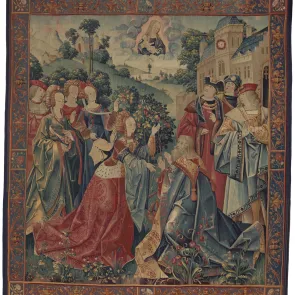
The Tapestry Series of Honor is a set of tapestries created in the early 16th century in the Southern Netherlands. The Musée de Cluny preserves three fragments depicting "The Death of Honor," "The Triumph of Honor," and "The Fates."
The ancient themes, revived during the Renaissance, are treated in a spirit still influenced by medieval mindsets. With numerous characters arranged in pastoral settings punctuated by buildings, this type of tapestry is characteristic of the Netherlands at the end of the Middle Ages.
Qualities and flaws, good or bad deeds, are personified and associated with heroes from antiquity. However, the costumes are predominantly those worn in the early 16th century. The landscape decor, on the other hand, is inherited from medieval representational styles.
The first tapestry fragment is "The Death of Honor." It shows a personification of the soul of Honor. Partially nude, it is stripped of earthly trappings. Youthful in appearance, it is an asexual and crowned figure.
The soul is surrounded by the personifications of the three theological virtues, identified by the Latin inscriptions beside them. Faith ("fides") is represented by a nun, Charity ("caritas") and Hope ("spes") by two other women. Two angels lift the soul of Honor toward God the Father. Surrounded by a double circle of red and then white angels (burning with love and pure), God, crowned, holds the terrestrial globe and makes a gesture of blessing. The tapestry illustrates the discourses of the learned rhetoricians of the late Middle Ages, who saw honorable and virtuous conduct as the key to salvation.
The second tapestry fragment is "The Triumph of Honor." The scene depicts an old man, "Decus" (Honor in Latin), on a chariot within a procession. It is inspired by an ancient triumph. By their costumes, the members of the procession appear to be people from the early 16th century. But their names are those of ancient heroes or characters, such as Ulysses or Hippocrates. In the foreground, a man in ecclesiastical attire and a woman have perished under arrows. These may have been shot by the two women depicted in the corner, Pleuresy (a disease) and her companion. Here, the iconography of triumph and the character riding a brown ox on the right refer to the work of the Italian author Petrarch (14th century), who contributed to the introduction of the Renaissance in literature and the arts.
The third tapestry fragment represents "The Fates." In ancient mythology, the Fates are three spinners who spin, wind, and then cut the thread of human life. Here, there are four women, identified as two Fates, Clotho and Lachesis, and two diseases, Frenesis and Colicapasio. This may be a remnant of a scene depicting the triumph of Honor over death and the ills of humanity, as the four female figures hold chains, likely to pull a triumphal chariot.
The three tapestry fragments come from the museum's old collection and likely from the collection of Alexandre Du Sommerard.