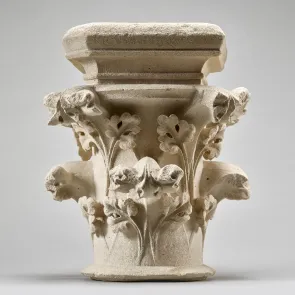
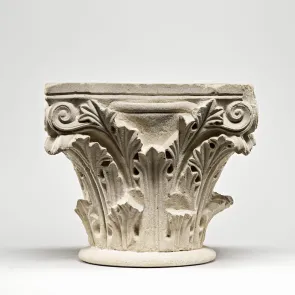
These two vegetal-decorated capitals likely originate from a religious building on the Île de la Cité. They are characteristic of the early Gothic period. Both have identical dimensions and are sculpted on all four faces of a cubic block.
One of them features a three-strand foliage pattern passing through four anthropomorphic heads at the center of each of the four faces. Two stems emerge from their mouths downward and from their skulls upward, intertwining at the corners and blooming into half-palmettes. Additionally, palmettes placed above each "mask" exhibit varied shapes that distinguish the different faces. The basket of the other capital is sheathed in four large, smooth leaves that curl toward the corner in a powerful volute.
These compositions are characteristic of the repertoire of early Gothic sculpture, which developed in the Île-de-France region from the mid-1130s. Notably, the pattern of foliage emerging from the mouths and ears of grimacing masks is found on a capital in the ambulatory of the Parisian priory of Saint-Martin-des-Champs, dating to around 1135. Slightly later, it forms a connecting motif between the sculpted medallions of the Labors of the Months on the south portal of the west façade of the abbey church of Saint-Denis. This motif originated in England, where it belongs to the illuminated repertoire of the "Winchester School." It is often associated with the letter B, taking the form of a leonine head that binds the two curves of the initial in the manner of an engoulant. While the transcription of the motif at Saint-Martin-des-Champs seems perfectly informed by the meaning of the model, the one proposed by the recently acquired capital reveals a certain lack of understanding. In fact, the awkward articulation of the elements, the unfinished palmettes of the first capital, or the variations in size and height of the volutes of the second can likely be explained by their material: white marble, an unusual material in the corpus of early Gothic sculpture. Clearly, a sculptor accustomed to working with limestone found themselves grappling with an unfamiliar material, whose hardness they had to confront with ill-suited tools, likely resulting in a simplification or even distortion of their style and the motifs treated.
Furthermore, the irregular shape of the capitals likely indicates the reuse of ancient sculptures, with the sculptor having to adapt to the preexisting form of the blocks. The location of their discovery is significant. They were unearthed in Place Saint-Michel in Paris during the alignment and reconstruction works directed by Gabriel Davioud at the request of Prefect Haussmann. Combined with the specificity of the material, this location suggests that they belonged to a prestigious building on the Île de la Cité, such as the cathedral, or on the Left Bank, like the abbeys of Sainte-Geneviève or Saint-Germain-des-Prés, all of which had access to ancient or early Christian "spolia" related to the development of Lutetia in these areas. The fact that they are not engaged but sculpted on all four faces, as well as their reduced dimensions, suggests that they were cloister capitals.
Discovered during the development of Place Saint-Michel, Paris, by Alfred Achille Napoléon Feine (1827–1899), architect; donated by his great-grandchildren Claude Bernateau, François Froté, and Nathalie Audebert.