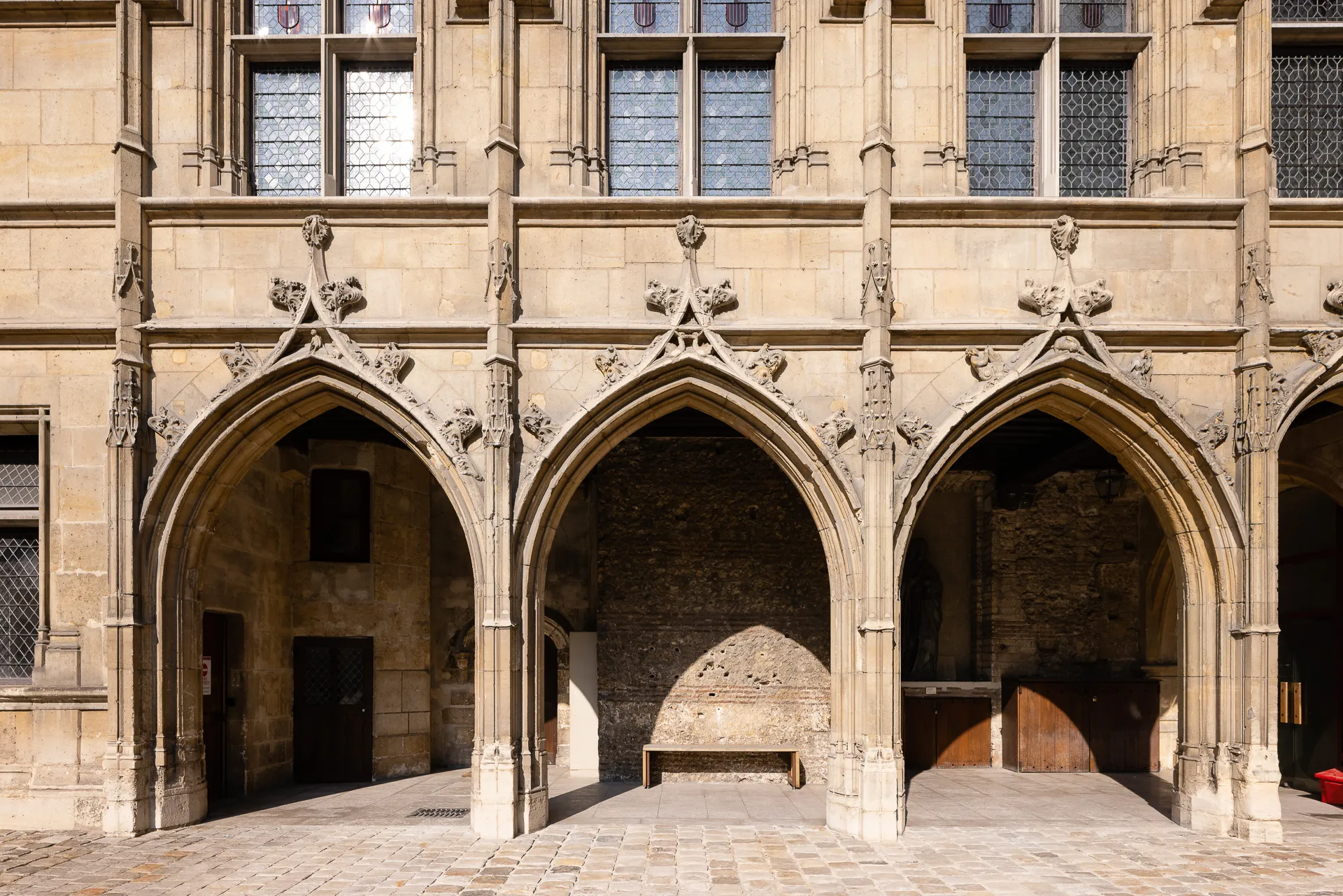
Une façade de l'hôtel médiéval côté cour. © Alexis Paoli / OPPIC
The museum throughout the years
During the 20th century, the presentation of the collections of the Musée de Cluny evolved. The Du Sommerard family’s cabinet of curiosities gradually came to specialise in mediaeval art.
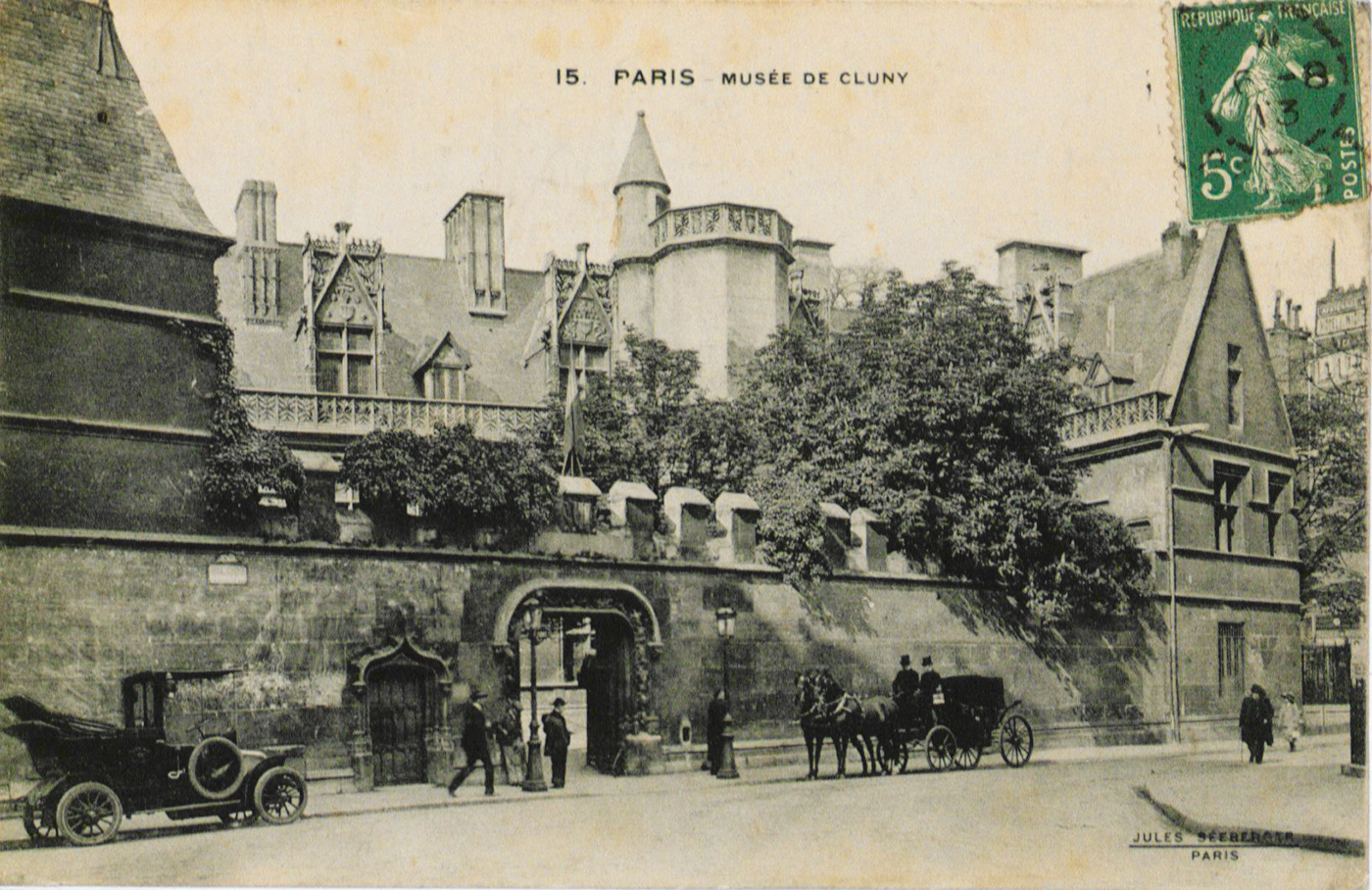
Postcard, exterior view of the Musée de Cluny
The Musée de Cluny in the 1900s
In the early 1900s, Edmond Haraucourt (director of the Musée de Cluny from 1903 to 1925) published the first two volumes of his "General Catalogue of the Musée des Thermes and the Hôtel de Cluny". His ambition is to compile a comprehensive inventory of the collections.
The following volumes would never be published. But even incomplete, his publication allows us to better understand how the collections were organised at that time. Postcards published between 1904 and 1906 also serve to illustrate the museum's museography during this period.
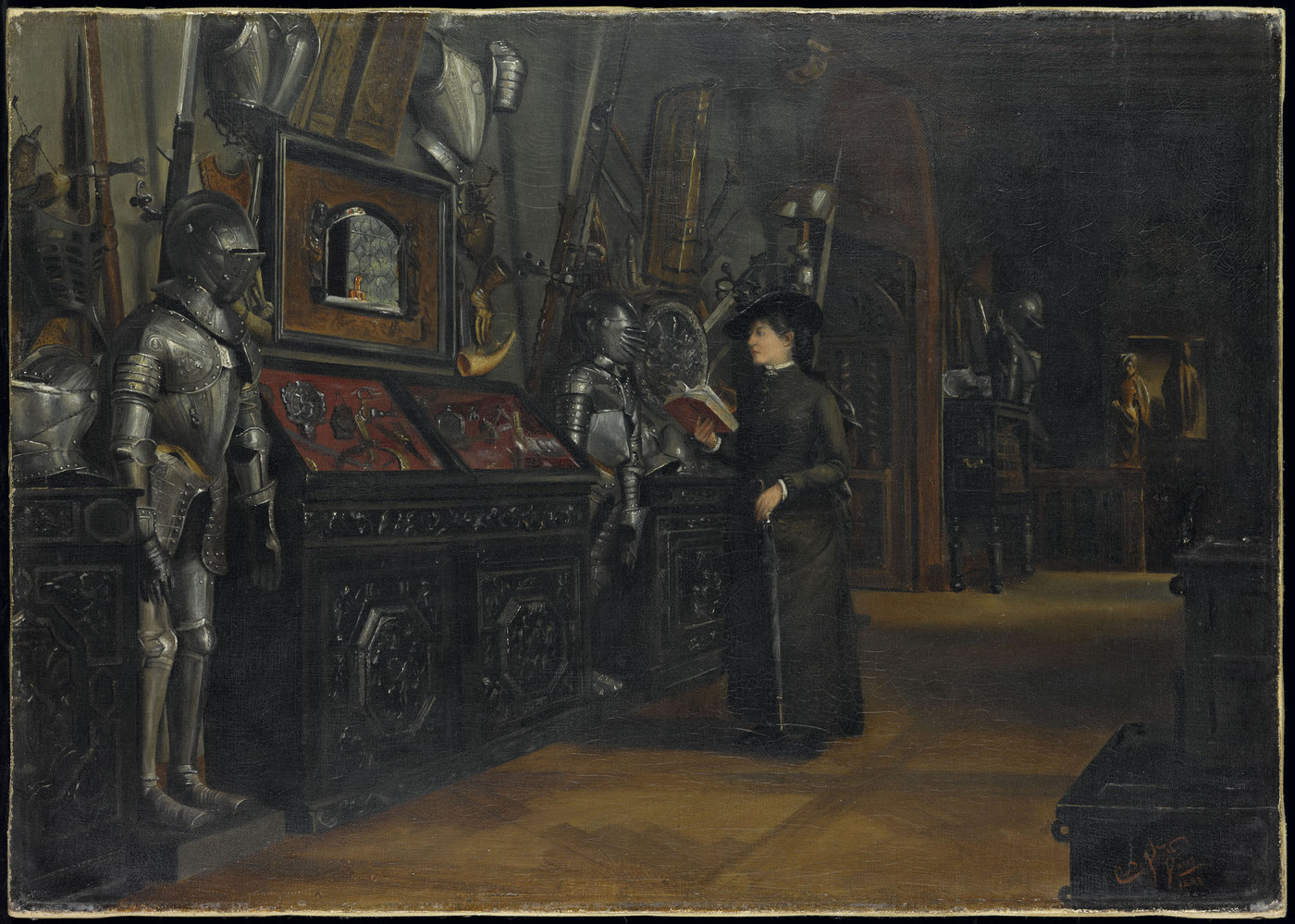
The arms gallery at the Musée de Cluny, Cl. 23882 © GrandPalaisRmn / Michel Urtado
A "traditional" cabinet of curiosities
At the dawn of the 20th century, the Musée des Thermes et de l'Hôtel de Cluny still looked like a cabinet of curiosities. The collections were showcased for their inherent aesthetic beauty rather than their historical significance. The presentation was aimed at an audience of connoisseurs, but remained not easily accessible for the general public. The labels offered little insight and were limited to the title of the work and an approximate date.
The available space was used to its fullest to display the works. In the altarpiece room, the wall could barely be seen due to the amount of pieces arranged over several rows. The pillars of the carved wood room were used to display the statues as if they were part of the structure. These choices reflect a decorative approach to the works.
The museum's collections span a period from the 1st to the 17th century. However, an analogical approach was chosen over a chronological one. Works were grouped by type: rooms dedicated to a technique, material or type of object. As such, in the "frigidarium", where stone sculptures from the 1st to the 14th century were displayed, the works were organised by category: on one side, the capitals; on the other, the flat elements (funerary slabs, tombs, altarpieces, etc.), with the massive ancient remains in the centre of the room.
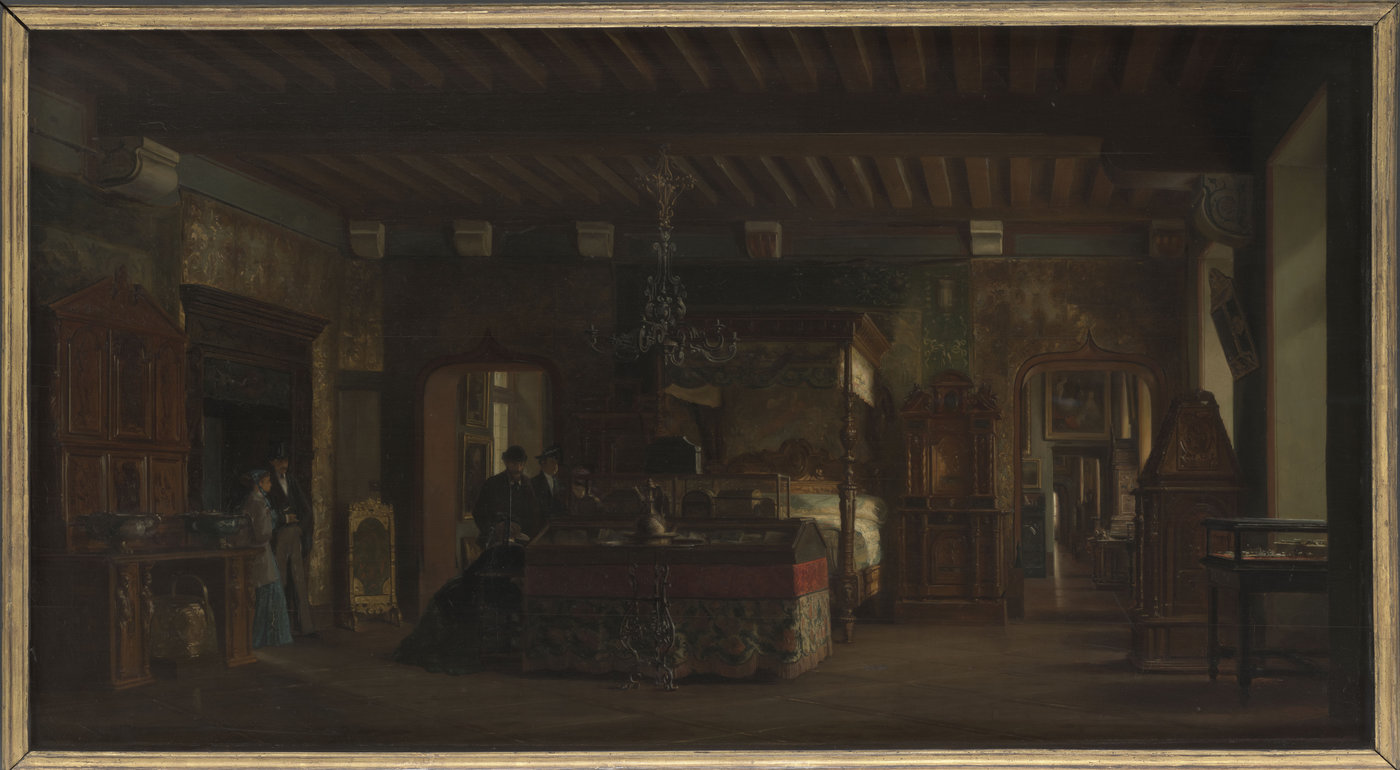
The chamber of François Ier © GrandPalaisRmn / Michel Urtado
Putting objects back into context
To recreate the atmosphere of an era, some rooms were designed as period rooms. Using objects available in the collections, they reconstructed the decor and layout of a room from a specific period. At the Musée de Cluny, the "François Ier room" was one of the most popular spaces with visitors. Dedicated to the Renaissance, it was furnished in the style of a private chamber from the early 16th century.
This focused on restoring meaning to the displayed objects by placing them back in their context, even if it led to a level of dramatisation. As in the middle of a nave, a large German châsse (shrine) was as such surrounded by four candlesticks in the centre of the carved wood room. The staging in this case referred to the use of these ancient liturgical objects. Even when taken out of context, the purpose of these museum pieces was highlighted.
Similarly, some works were sometimes used as supports for others. A podium base was used to display the mourners at John the Fearless' tomb in the carved wood room. However, this museography contributed to increasing confusion between the eras and could sometimes betray the meaning of the works.
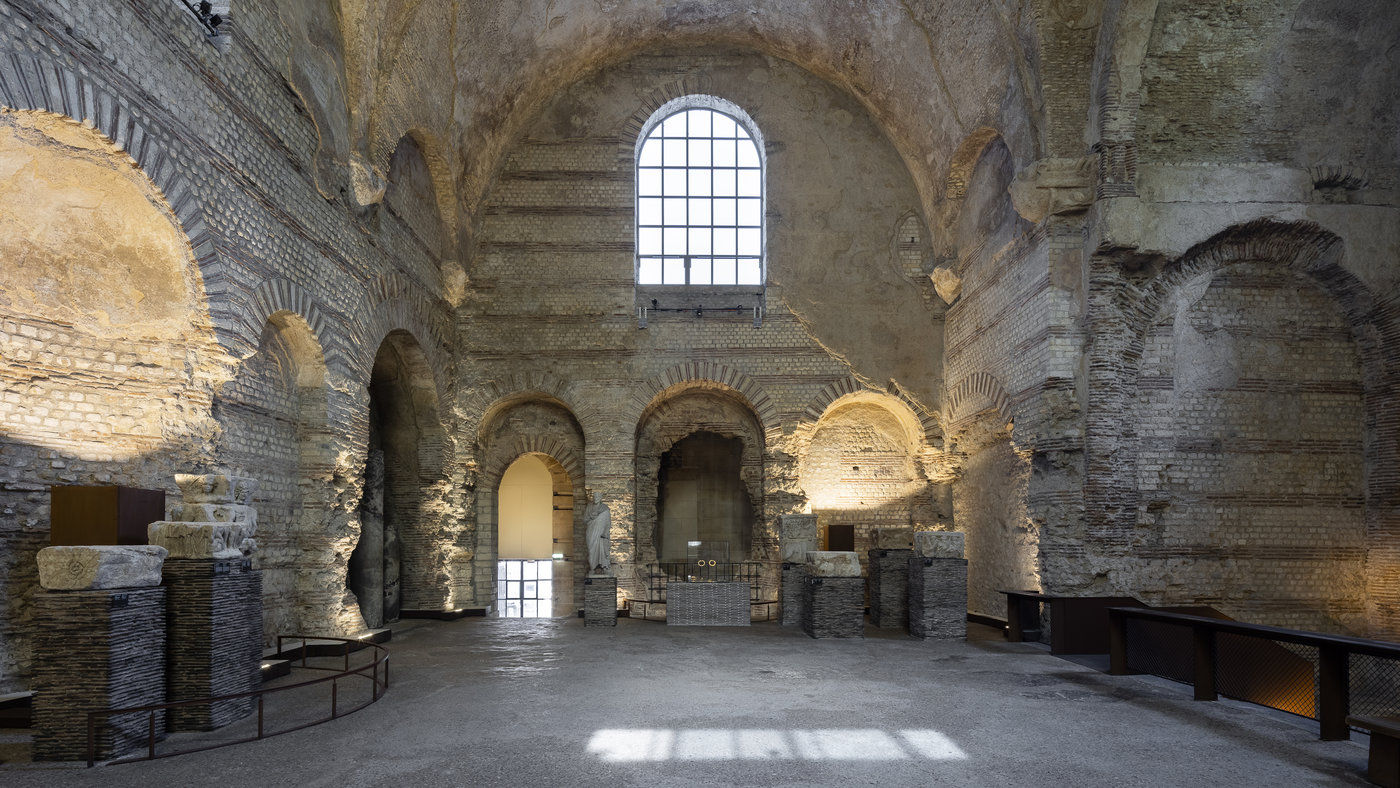
Room 1, Frigidarium © Alexis Paoli / OPPIC
The museum in the second part of the 20th century
At the beginning of the Second World War, the museum was closed and the collections evacuated to protect them from the combats. Part of the works, including the Lady and the Unicorn’s tapestries, were therefore temporarily kept at the château de Chambord.
The "Book of Guilds" model
In the years following the end of the war, Pierre Verlet and Francis Salet were responsible for moving the collections back to the museum. They choose to refocus the approach on the Middle Ages. Some of the more recent works were on deposit at other institutions, including the National Ceramics Museum in Sèvres and the International Shoe Museum in Romans-sur-Isère.
While ancient works were presented in the Roman baths' "frigidarium", mediaeval objects were displayed according to a typological framework (by type of media and materials), inspired by the "Book of Guilds" written by Etienne Boileau at the end of the reign of Louis IX. Some themed rooms were also created, including one dedicated to Alexandre Du Sommerard. Bringing together pieces from all eras, it reflects the mindset of collecting objects that prevailed in the museum’s founder’s collection.
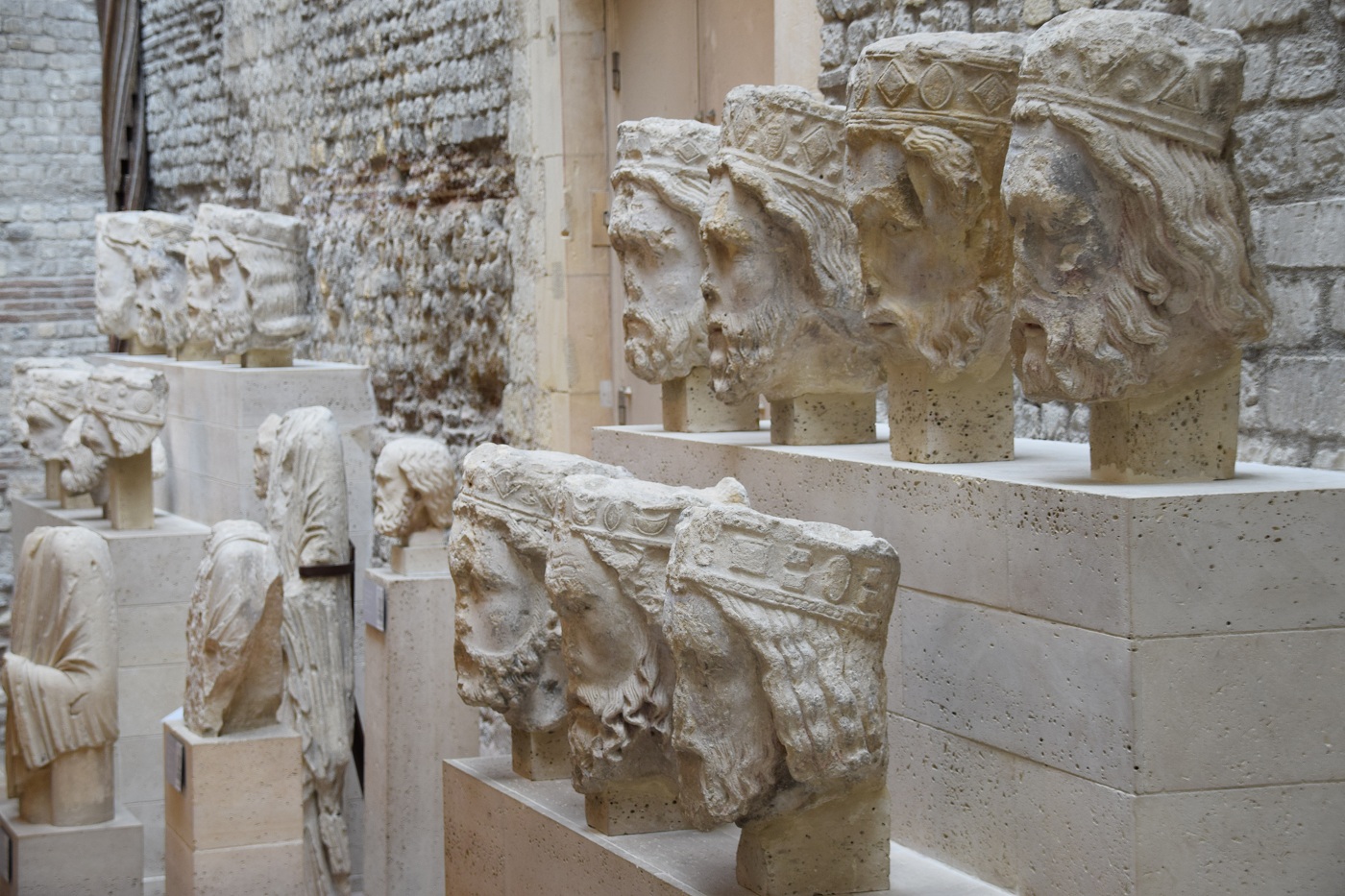
Heads of the kings of Judah in the Notre-Dame Room © musée de Cluny - musée national du Moyen Âge
Towards a museum of the Middle Ages
In 1977, the National Museum of the Renaissance was created and installed in the Château d'Écouen. More than 5,000 objects from this period left the collections of the Musée de Cluny and were transferred to Écouen.
In the same year, sculpted fragments were discovered in the foundations of a private mansion on rue de la Chaussée d'Antin. The Hôtel Moreau was the headquarters of the French Bank for Foreign Trade. Archaeological excavations conducted over the course of a year revealed the presence of several hundred sculpted pieces, and it was quickly established that they came from Notre-Dame cathedral in Paris. Among these elements, 21 monumental heads from the gallery of the Kings of Judah, situated on the western façade of the cathedral, were identified.
These sculpted heads, along with 300 other fragments, joined the collections in the Musée de Cluny. Alain Erlande-Brandenburg, the museum director, converted a room that was previously used for storage to display these exceptional works.
From 1981, the museum's layout was extensively redesigned. On the ground floor, a stained glass room was created to display pieces from the 12th and 13th centuries. Above the Notre-Dame room, a vault room houses the most precious pieces of goldsmithery.