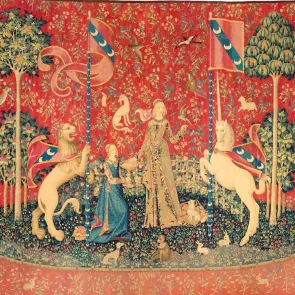
The Seigneurial Life cycle is a set of six millefleurs tapestries created in the early 16th century. They depict the daily life of ladies and lords around the year 1500. The exact place where they were woven remains uncertain.
The background of these tapestries is scattered with wildflowers and plants, earning them the name millefleurs. Around twenty botanical species are present here, along with shrubs and fruit trees that evoke the appearance of an orchard. Birds animate this natural setting, perched on trees and bushes, flying through the air, or on the ground. Often depicting secular scenes, millefleurs tapestries perfectly fulfill their decorative role. This idyllic nature serves as a living backdrop for the characters portrayed.
The Seigneurial Life tapestry series portrays the lives of aristocratic elites around the year 1500. Lords and ladies are accompanied by their servants. The garden becomes a place of pleasure for them, engaging all the senses. Numerous activities are depicted, embodying refinement in the aristocratic ideal: strolling, fruit tasting, bathing with music, embroidery, reading, and hunting.
In the first tapestry, titled "The Promenade" (Cl. 2178), a lord and lady stroll in the company of a young page and two maidservants. One of the maidservants has picked flowers, while the other offers a tray of fruit to her master and mistress. Both maidservants are dressed in styles common in early 16th-century France, characterized by wide, flared sleeves. The lady of the manor, however, follows Italian fashion with "slashed" sleeves made of two overlapping layers. These sleeves are tied with ribbons and reveal a more delicate fabric underneath. The lady also sports another detail imported from Italy: her hair is styled in braids that frame her forehead, tied with a lace. The lord, on the other hand, wears loose, mid-length garments and shoes with rounded toes ("bull-nose" style). He holds a flask bearing the arms of France.
The second tapestry, titled "Gallant Scenes" (Cl. 2179), depicts noble characters, maidservants, and servants. The latter bring fruits and sweets to their masters. In the lower left, a couple seated on the grass is embracing. In the center, another couple is seated on the grass. The lady holds a parrot on her left hand, which may symbolize the celebration of courtly love. Around them, some birds take flight, while others perch in the trees, under the watchful eye of a lurking fox.
In the third tapestry, titled "The Bath" (Cl. 2180), the lady is depicted from the waist up in a luxurious Renaissance-style basin adorned with motifs inspired by antiquity, such as lion heads and acanthus leaves. She is surrounded by her maidservants. One holds a jewelry box, while another carries a tray of fruit. They wear attire following French fashion. In the background, a woman dressed and coiffed in the Italian style plays the lute. Beside her, a man plays the recorder.
In the fourth tapestry, titled "Embroidery" (Cl. 2181), on the left, a seated lady decorates one side of a cushion resting on her lap. She embroiders flowers that echo the millefleurs background of the tapestry. She also embroiders the Christogram "IHS" (an abbreviation of Jesus' name), a sign of devotion and virtuous conduct. Beside her, a basket contains balls of thread. On the right, a maidservant brings her a standing mirror along with more thread. The lady wears a gold brocade dress lined with fur, following French fashion. Her maidservant, equally richly dressed, follows Italian fashion.
In the fifth tapestry, titled "Reading" (Cl. 2182), a lord sings, recites verses, or reads to a lady he is courting. She is seated on a richly adorned chair, spinning with her distaff. A small dog sits on her lap, barking at the cat playing on the floor with a ball of yarn.
The sixth and final tapestry depicts the "Departure for the Hunt" (Cl. 2183). On the left, a richly dressed lord holds a falcon on his gloved hand. His dog, likely a greyhound, sits at his feet. On the right, a halberdier leans on his pike. This somewhat unusual figure is borrowed from an engraving by Albrecht Dürer, "The Assembly of Soldiers" or "The Six Warriors" (c. 1495).
Without any marks of ownership, this tapestry series was likely woven in advance to be presented to potential buyers, who would have been charmed by these nature-inspired decorations.
The weavers used the process of reusing cartoons, or full-scale models. In this regard, one can note the similarities between the two young women carrying trays in "The Bath" and "The Promenade." The reuse of standard silhouettes is characteristic of millefleurs tapestries. Consequently, the characters are not always depicted in relation to each other in a narrative or representation. They often seem to ignore one another.
Nevertheless, these compositions exude a poetic and lively atmosphere, enhanced by the precision of anecdotal details such as the kitten pulling the thread ("Reading") or the ducks paddling in the pond ("The Bath").
Between the flowers evoking the Garden of Paradise and the characters embodying courts of love, millefleurs tapestries are the pictorial transposition of the courtly poetry of the time. These tapestries recall, for example, the poetic work of the "Romance of the Rose," written in the 13th century, blending idyllic nature and courtly love.