The Musée de Cluny preserves a set of six capitals from the Abbey of Saint-Denis (cloister and abbey church), created between 1140 and 1145. They illustrate the expertise of sculptors from the first generation of Gothic art.
Five of the capitals were located in the abbey's cloister. Built around 1145, this cloister is almost contemporary with the western façade of the abbey church (circa 1135). Under the leadership of Abbot Suger (1122–1151), this vast project contributed to the emergence of the new Gothic style. The cloister galleries were marked by an alternation of single and double capitals. Some crowned small statue-columns. The galleries were destroyed in the mid-18th century.
The cloister capitals highlight how the first generation of Gothic sculptors mastered the art of variation by diversifying their designs.
Among those preserved in the museum, four are double capitals. They consist of two paired baskets. These capitals are populated by a rich and varied bestiary, recombining all the fantastical motifs from the repertoire of Chartres Cathedral. Around the same time (circa 1145), the sculptors of the Saint-Denis capitals also used these motifs in the capitals of the apse of the abbey church of Saint-Germain-des-Prés. Alongside these animal motifs, these capitals are also adorned with vegetal ornaments adapted from the Corinthian model.
The first of the four double capitals (Cl. 18925a) features two large, similar faces. They are decorated with a griffin and a chimera facing each other—these are called "affronted" capitals. The design of the confronting creatures harmoniously fits the structure of the double capital, with each monster occupying one of the two baskets. The creatures on the main faces rest their front paw on a human head, a posture likely symbolizing the hold of sin over humanity.
The second capital (Cl. 18925b) has two small faces adorned with acanthus leaves and two large faces decorated with fabulous creatures with bird bodies, serpent tails, and lion paws. These might be basilisks on one side and dragons on the other. They are placed in opposition, turning toward each other. On one of the two large faces, they are eating two grain-filled fruits escaping from a central bouquet of five leaves. On the other large face, the scene is almost identical, but the monsters' jaws reveal two rows of teeth.
The third capital (Cl. 19051) is adorned with acanthus leaves similar to those on capital Cl. 12119. On one of the two large faces, between the paired baskets, a lion's head can be recognized by remnants of its mane and lips revealing sharp fangs.
The last double capital (Cl. 23531) is decorated with male and female bird-sirens facing each other on the two large faces. These sirens are set within bouquets of palmettes. The long tails of the sirens intertwine on the two small lateral faces.
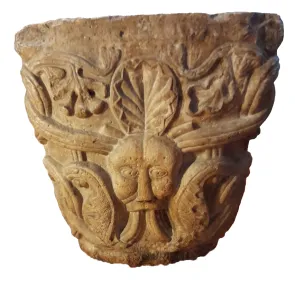
The final cloister capital is a simple capital with acanthus leaf decoration (Cl. 12119), derived from the Corinthian type. It does not draw from the Chartres repertoire but is instead inspired by the marble models found in the early Christian basilicas of Paris and likely Saint-Denis itself. This was a period when this ancient repertoire was revived in Paris. The treatment of the large acanthus leaves enveloping the basket is common to the other capitals attributed to the cloister of Saint-Denis.
The sculptures of this décor demonstrate great inventiveness on the part of their creators. This exuberance carries a moralizing dimension. However, it was sometimes criticized: twenty years earlier, Saint Bernard had reproached the profane decorations of cloisters for distracting monks during prayer.
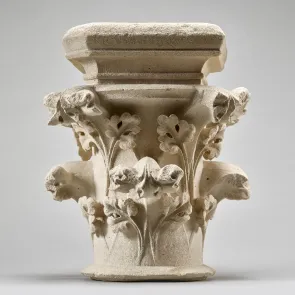
A final capital (Cl. 12637) from Saint-Denis preserved in the Musée de Cluny does not belong to the cloister, unlike the previously mentioned capitals. It likely belonged to the apse of the abbey church of Saint-Denis, which was rebuilt on the initiative of Abbot Suger between 1140 and 1144. It may have been located at the springing of an arch separating two radiating chapels. The basket is covered with two superimposed rows of acanthus leaves. Each corner is emphasized by a tall stem ending in a grain-filled fruit. The stems are framed by two long, serrated leaves. At the center of each face, beneath the abacus, emerges a head, sometimes feminine, sometimes masculine. This capital draws from both the Chartres repertoire for its figurative motifs and the early Christian repertoire for its acanthus leaves.