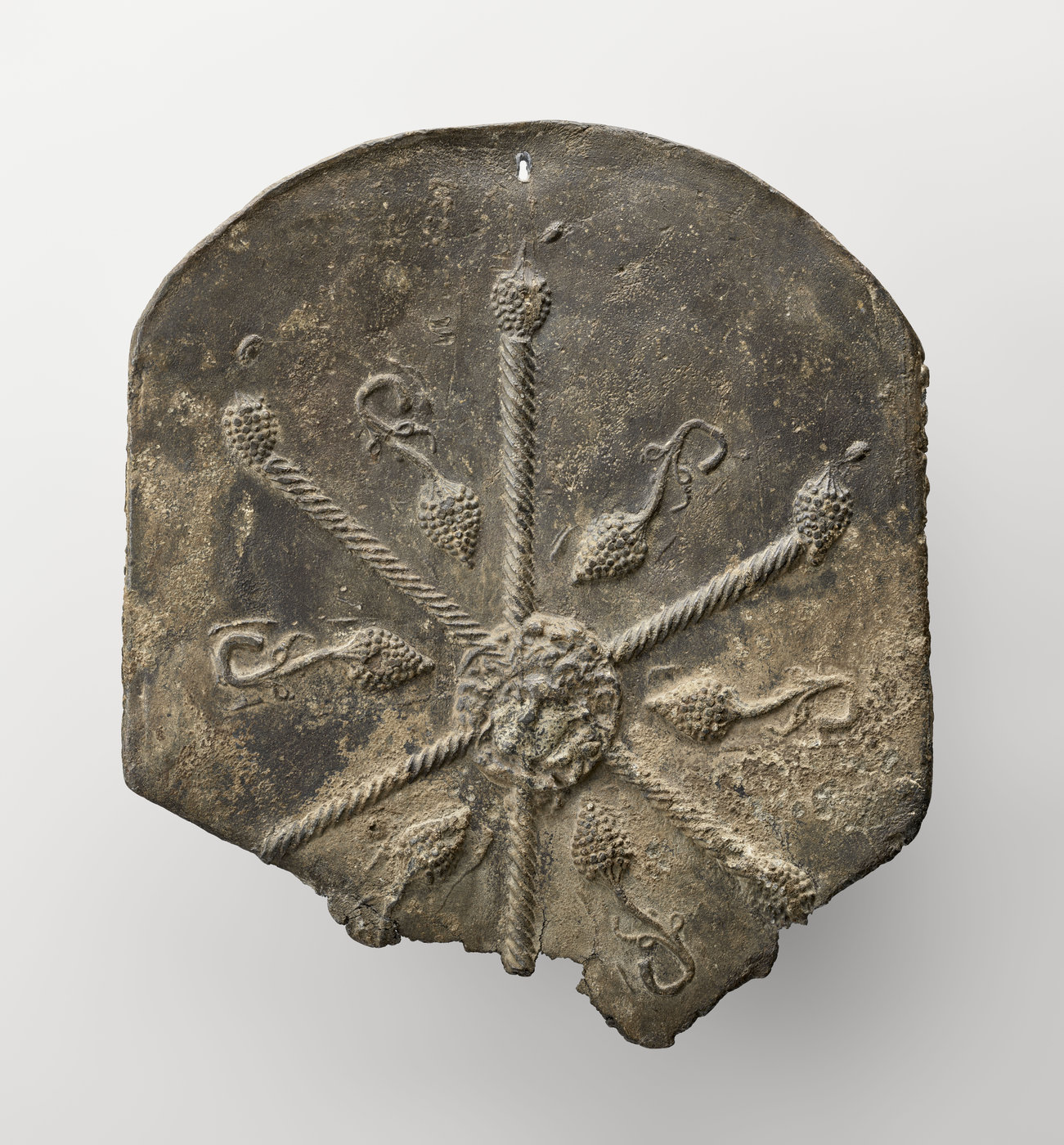
This sarcophagus slab, originating from a Gallo-Roman necropolis, features a Medusa’s head at its center. It may have been an imported sarcophagus, as its shape could indicate an Eastern origin.
This funerary relief is displayed in the frigidarium of the Thermes de Lutèce, the first room in the museum’s tour. An inscription on a label on its reverse side suggests that its discovery is linked to the excavation of Metro Line 10 (1930–1937). This line passed through the ancient necropolis in the Odéon area, which was identified in the 19th century by Théodore Vacquer.
This is a small side panel of a sarcophagus, partially damaged at the bottom. From the central Medusa’s head, twisted columns extend, ending in grape clusters that are also depicted with their vines in the empty spaces between the columns. The curved shape of the sarcophagus may suggest an Eastern origin, similar to certain sarcophagi found in the region of Tyre (Lebanon). It could have been an imported sarcophagus, indicating that the deceased belonged to the elite class of Roman Gaul.
Inventory number
Cl. 23975
Width
27,6 cm
Height
32 cm
Depth
0,6 cm
Place of discovery
Paris, Odéon (?)
Medium
Sculpture ; Stone
Method of acquisition
Donation by Michel Vernay n memory of Adolphe Schloss, looted by the Nazis