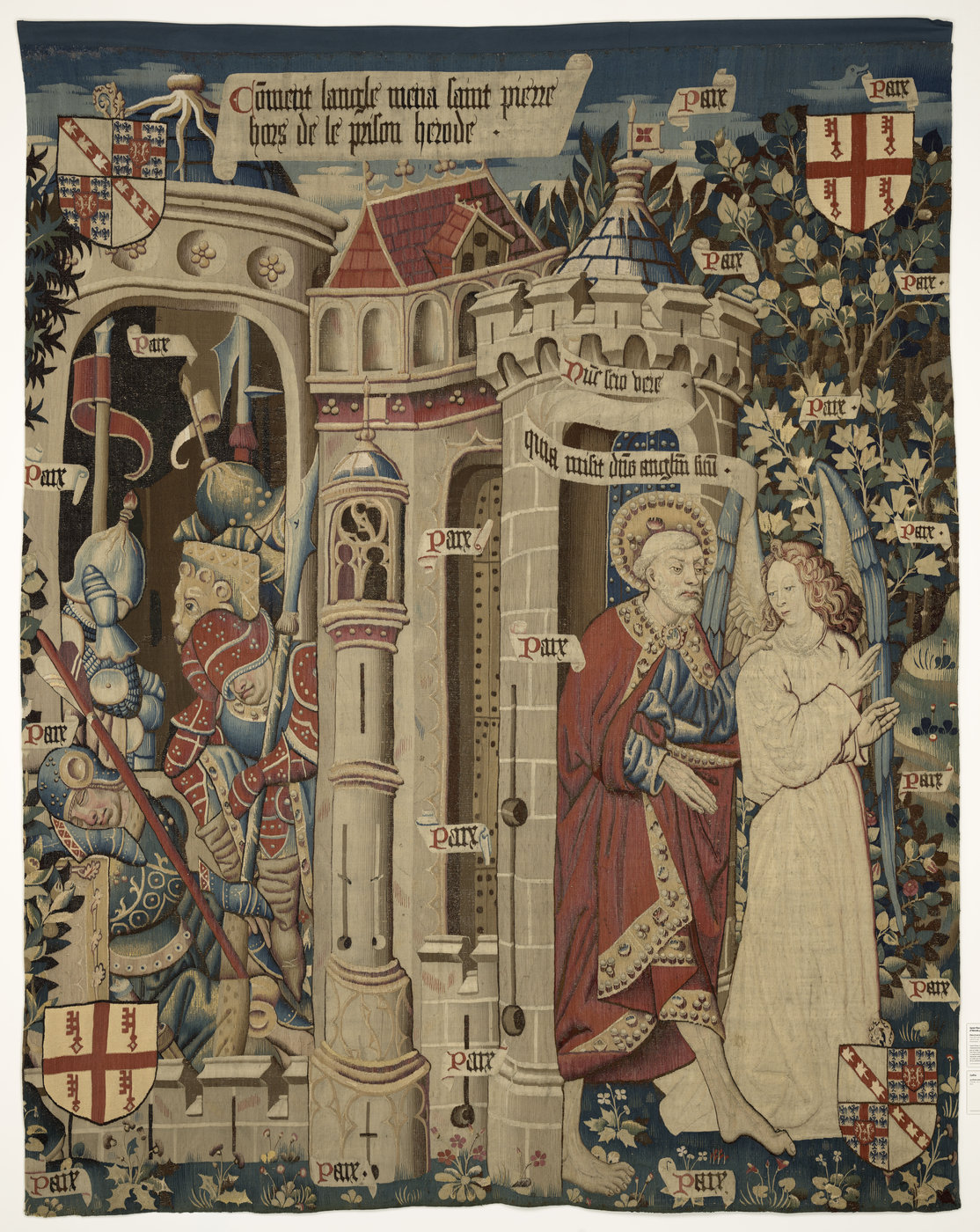
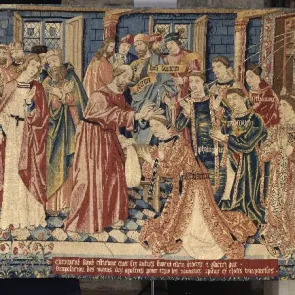
The tapestry "Saint Peter delivered from Herod’s prison" depicts an episode from the life of Saint Peter. The apostle, imprisoned in Jerusalem for preaching Christianity, was miraculously released from prison by an angel.
This is the fifth tapestry in a series depicting The History of Saint Peter. Only a third of the tapestry is still preserved today, which represents 10 tapestries.
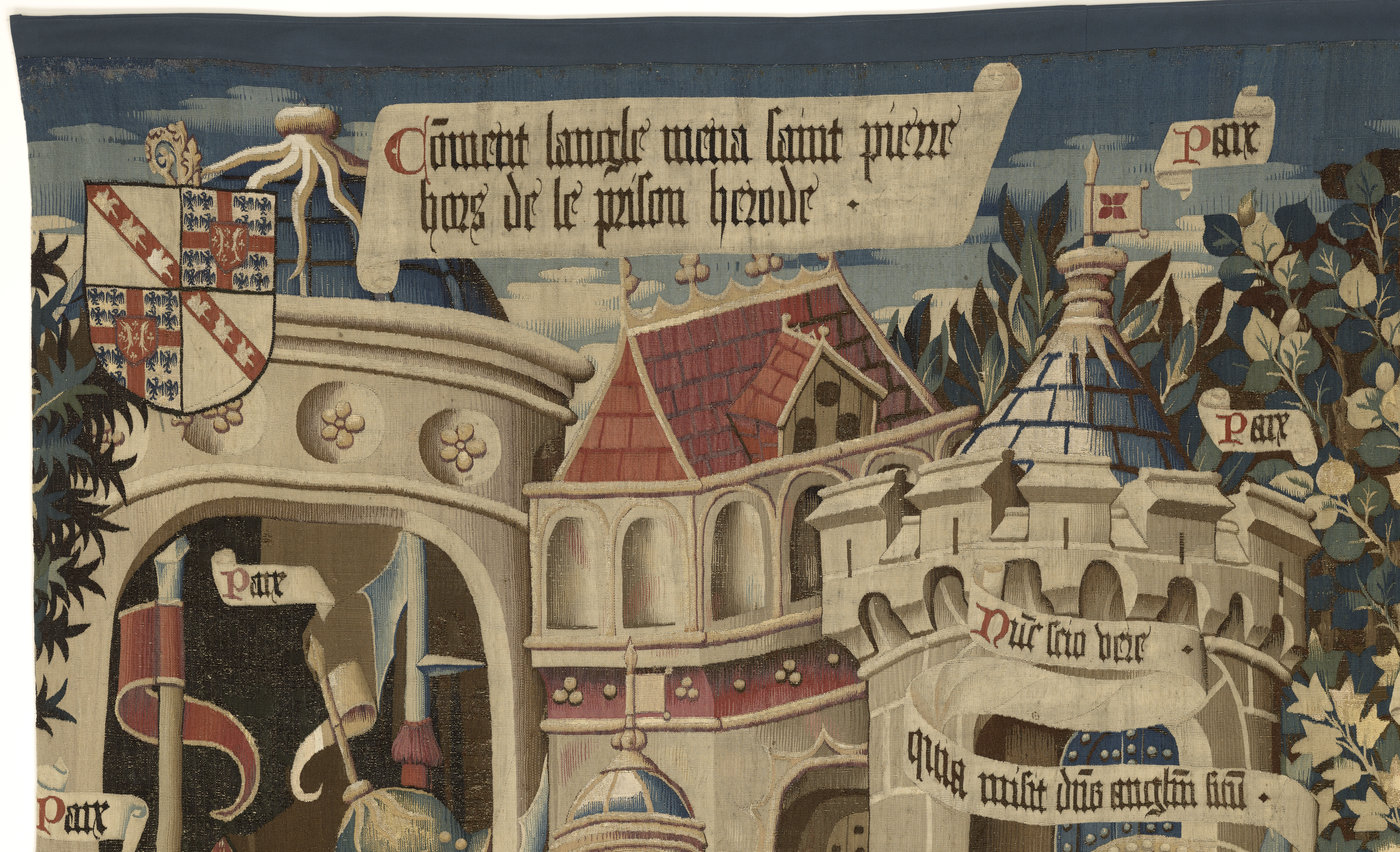
The inscription, located on the large banner at the top, describes the scene in ancient French (modernised here): "How the angel took Saint Peter out of Herod’s prison". On the left, four armoured soldiers, the prison guards, are depicted beneath elaborate architecture. They are heavily asleep with their helmets and weapons.
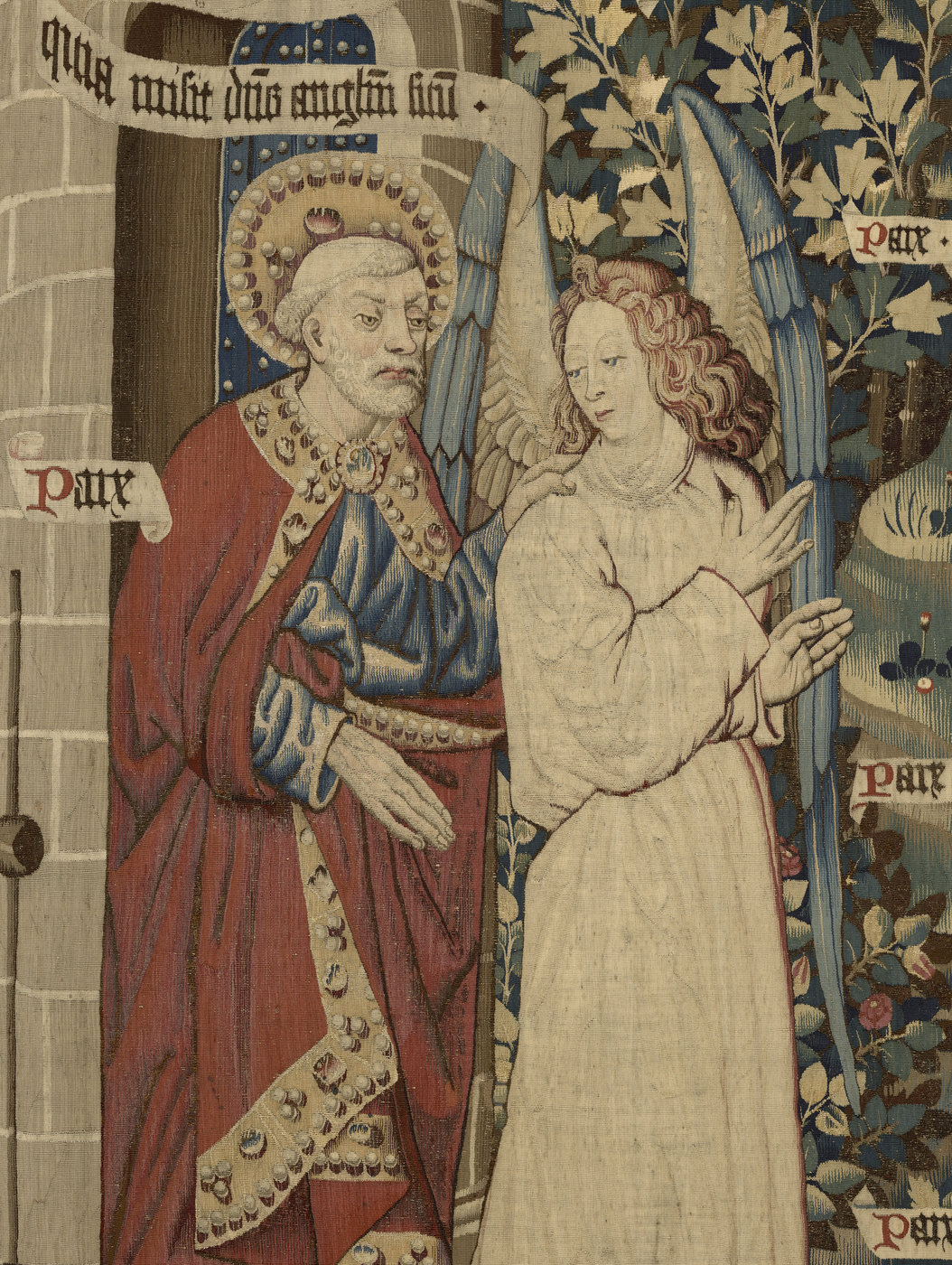
On the right, a white-robed angel with long wings is leading Saint Peter out of his prison. The apostle is dressed in a red cope trimmed with an orphrey, the colour of his future martyrdom. Her face is highlighted by a halo adorned with jewels.
Above Saint Peter, a phylactery bears a sentence in Latin: "Nunc scio vere quia misit Dominus angelum suum..." ("Now, I really know that the Lord sent his angel..."). This is a quote from the apostle as recorded in the Bible (Acts of the Apostles, chapter 12, verse 11).
The composition is particularly dense. Three curiously interlocked buildings occupy almost the entire space. These highly ornate architectures are a fantasy prison. The sky is confined to a narrow strip at the top. The green ground is dotted with flowering plants, and the vertical edges are outlined by shrubs.
The carefully woven tapestry shows intricately designed figures. Saint Peter is wearing a coat with abundant folds, clear shadows, and decorated (like his halo) with gemstones and pearls. The slumbering guards also wear highly decorated armour.
The series of tapestries this tapestry comes from was commissioned in 1460 for the choir of the Cathedral of Saint-Pierre de Beauvais by Guillaume de Hellande (bishop of the city from 1444 to 1462). He also had his coats of arms represented on the four corners of the tapestry, as well as those of the chapter (the governing body of clergy attached to the cathedral). The tapestry also features the bishop's motto, "peace," repeated eighteen times.
Although the place where the tapestry was woven is still unknown, it is likely that it was Arras or Tournai. This would mean that it was a piece imported to French land from Artois or Flanders. The person who produced the model was undoubtedly inspired by the style of Flemish painters from the first half of the 15th century. It might have been Jacques Daret (born in around 1403 – documented until approximately 1468). The Tournai-based painter was trained in Robert Campin’s workshop and also supplied works to churches in Arras.