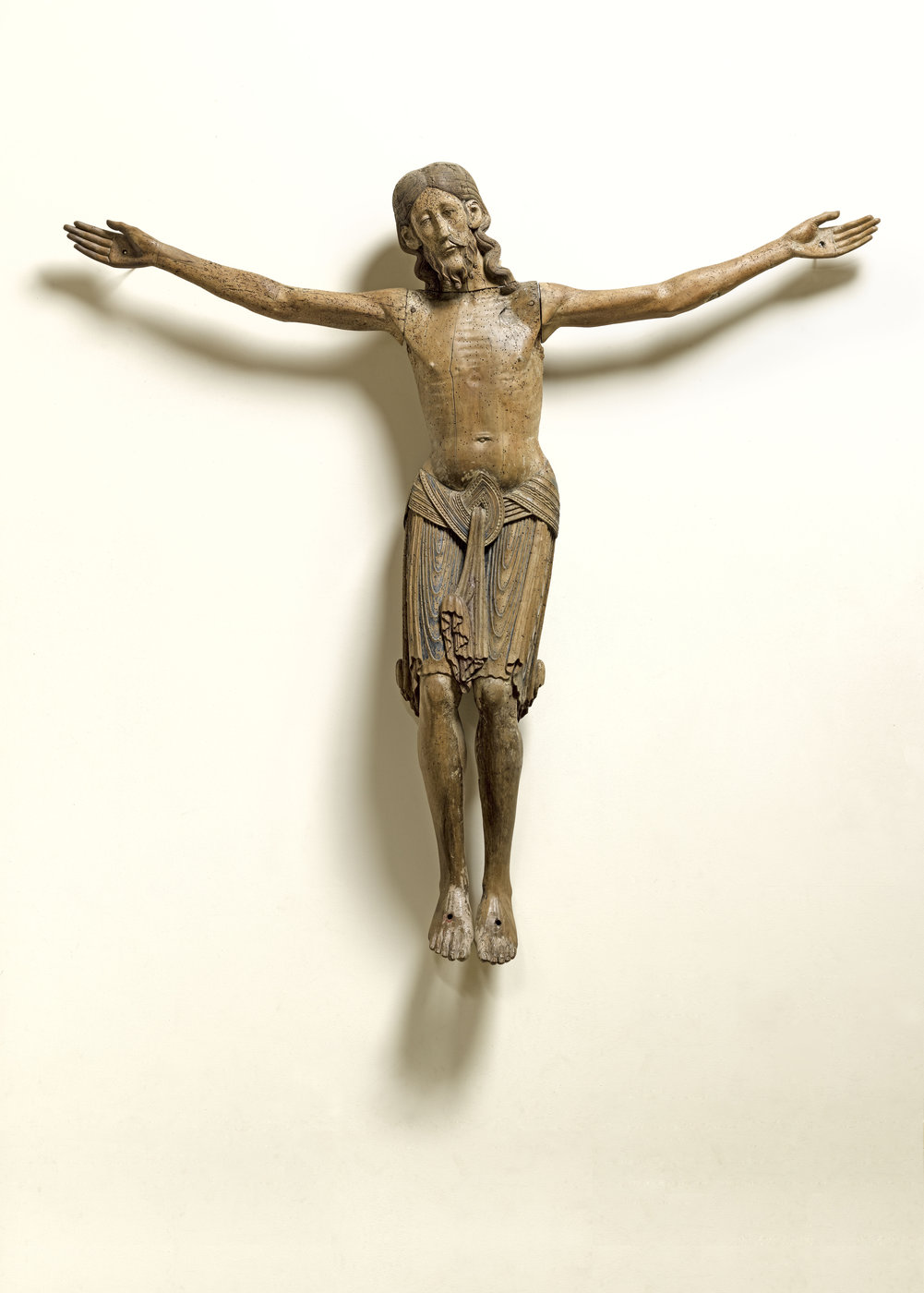
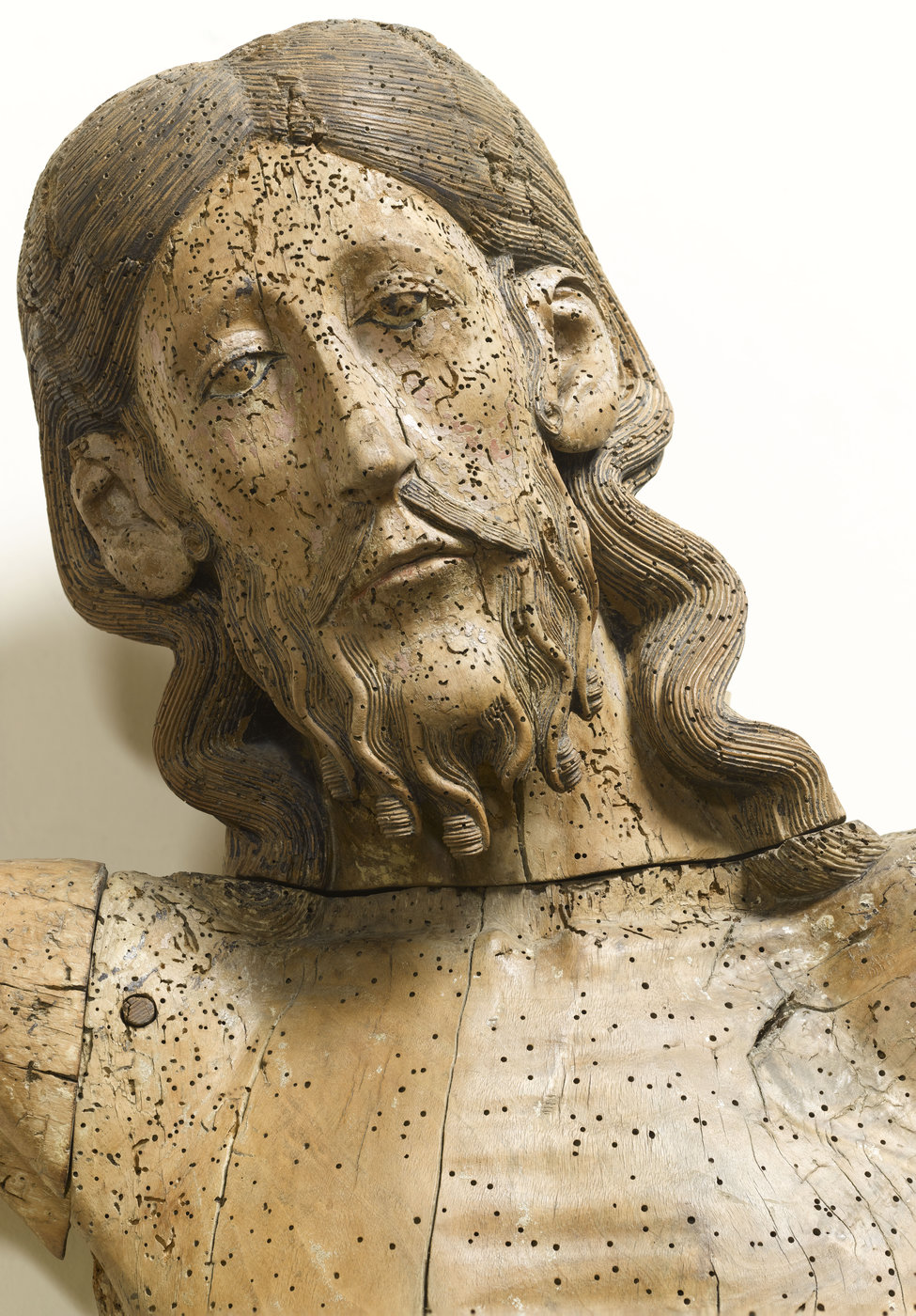
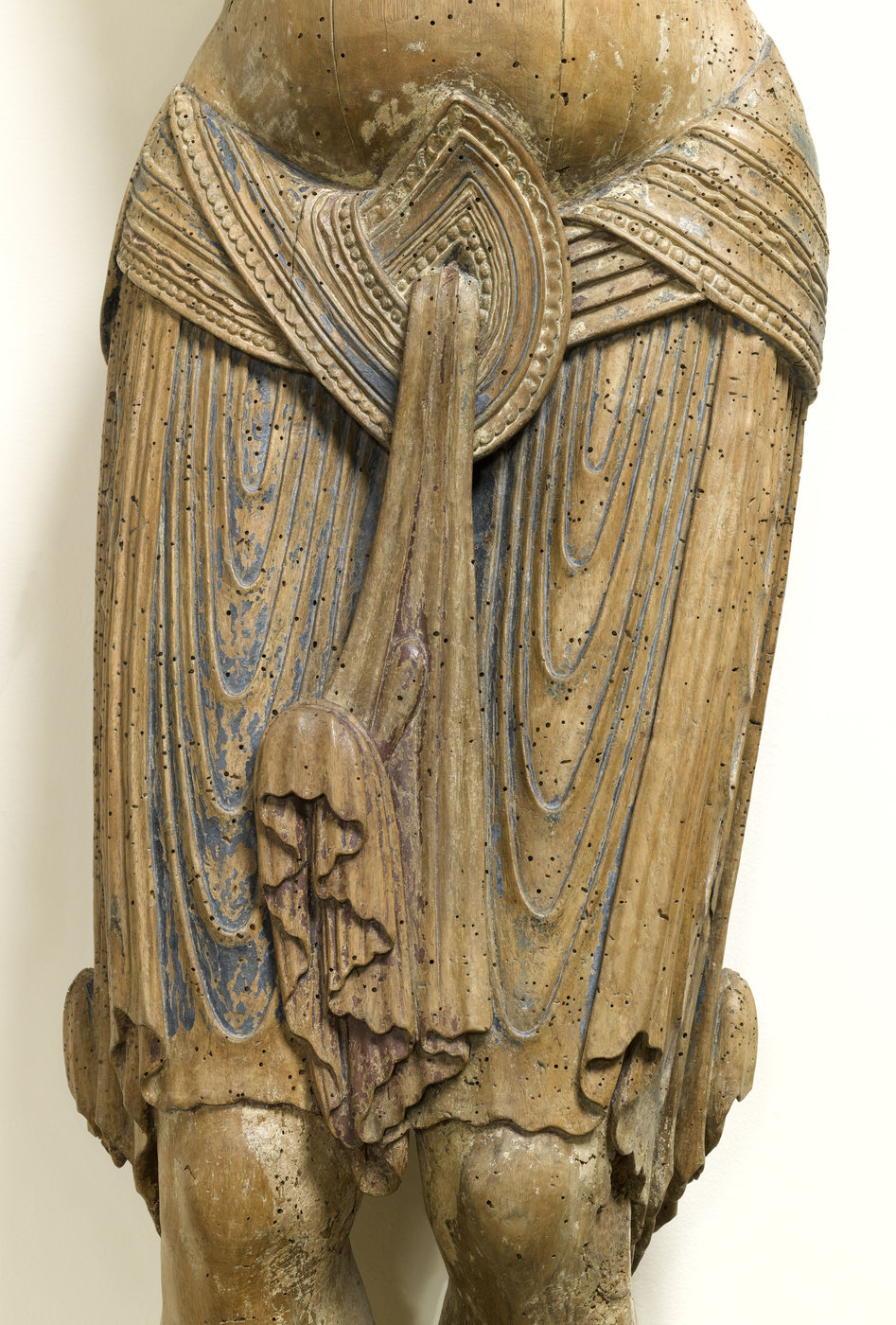
Crucified Christ, Cl. 2149 © GrandPalaisRmn / René-Gabriel Ojeda
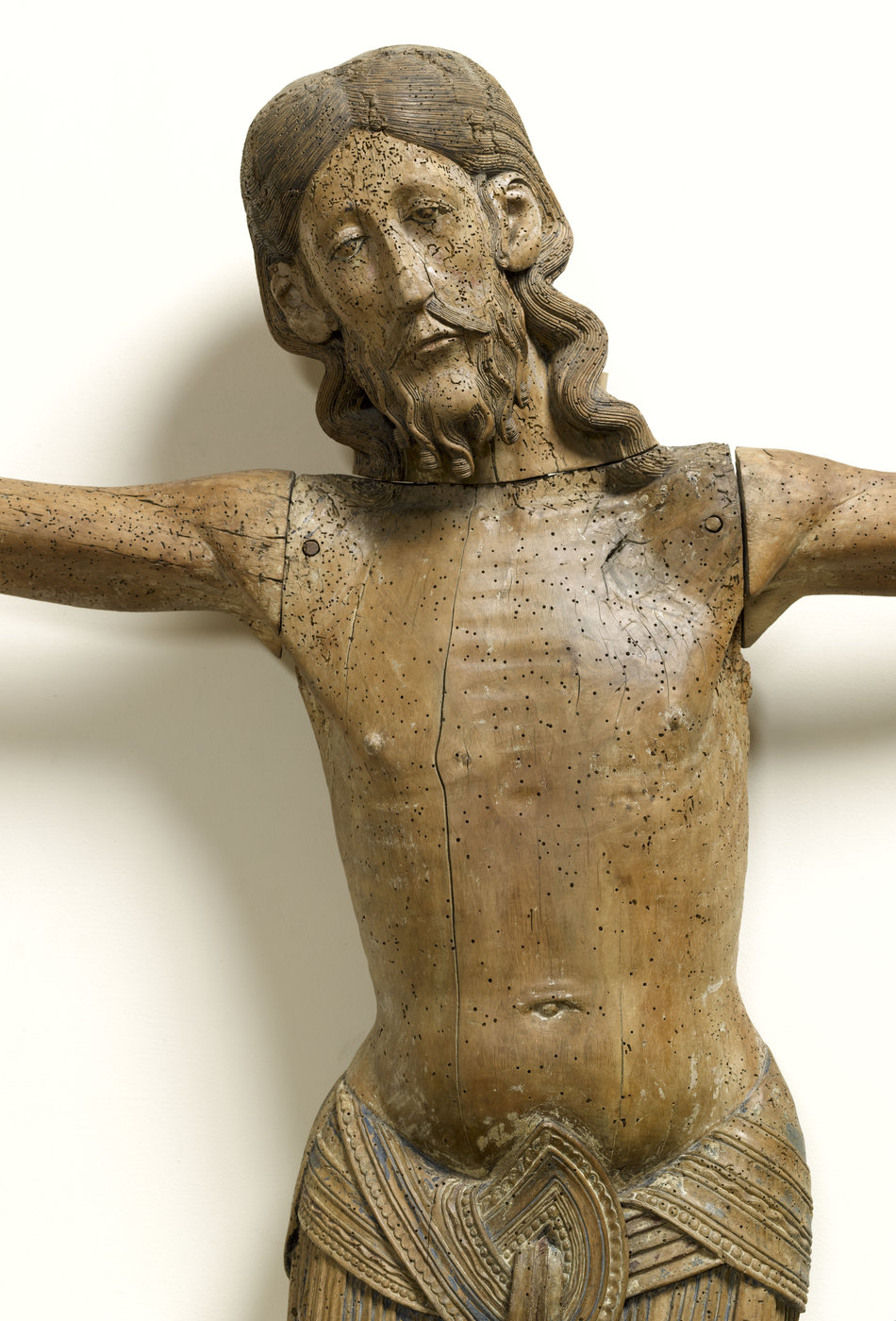
Crucified Christ, Cl. 2149 (detail) © GrandPalaisRmn / René-Gabriel Ojeda
Crucified Christ
Description
This polychrome wooden sculpture dates from the late 12th century or the beginning of the following century. It originates from Auvergne, a centre for the production of Romanesque sculptures during the Middle Ages, from which many Virgin and Child figures in majesty still remain, whereas almost all of the Crucified Christs have disappeared.
The crucified Christ bears the wounds left by the nails in his hands and feet. Yet, whereas until then the crucified Christs had been depicted as dead or suffering, with their eyes closed, this one appears particularly alive. He holds his head up and his eyes are open. His body does not slump and his arms are held almost straight. Here, Christ is depicted as alive, revived, and not dying.
The iconography of Christ victorious over death and triumphant on the cross emerged in Romanesque sculpture in the late 12th century. This sculpture is one of the finest examples of this.
The Christ was originally hung on a cross, which is now lost. One can imagine that it was meant for a beam of glory.
It comes from the church in Herment (Puy-de-Dôme). It stands out from the fifteen polychrome wooden representations of Christ preserved further south in Velay, due to its stylistic connections with Burgundian sculpture. As such it highlights the artistic connections that existed between the two regions during that time.
The sculptor has skilfully crafted the wood with great finesse. The hair and beard are styled in wavy strands, expertly arranged in a symmetrical fashion and precisely cut. The perizonium is intricately sculpted, as shown by the lines of the garment's folds. It is draped around his hips and tied at the waist with a complex knot that creates a delicate belt. The sculpture retains areas of original colour, which can be seen on the perizonium in particular.
This refinement is only found at an equivalent level in Christ du Vieux-Chérier (Loire). It may be the work of the same wandering sculptor, or from a workshop based in Auvergne, in Clermont for example.
| Inventory number | Cl. 2149 |
|---|---|
| Width | 189 cm |
| Height | 181 cm |
| Depth | 28 cm |
| Place of production | Auvergne |
| Medium | Sculpture ; Wood |
| Method of acquisition | Donated by Mallay, 1852 |