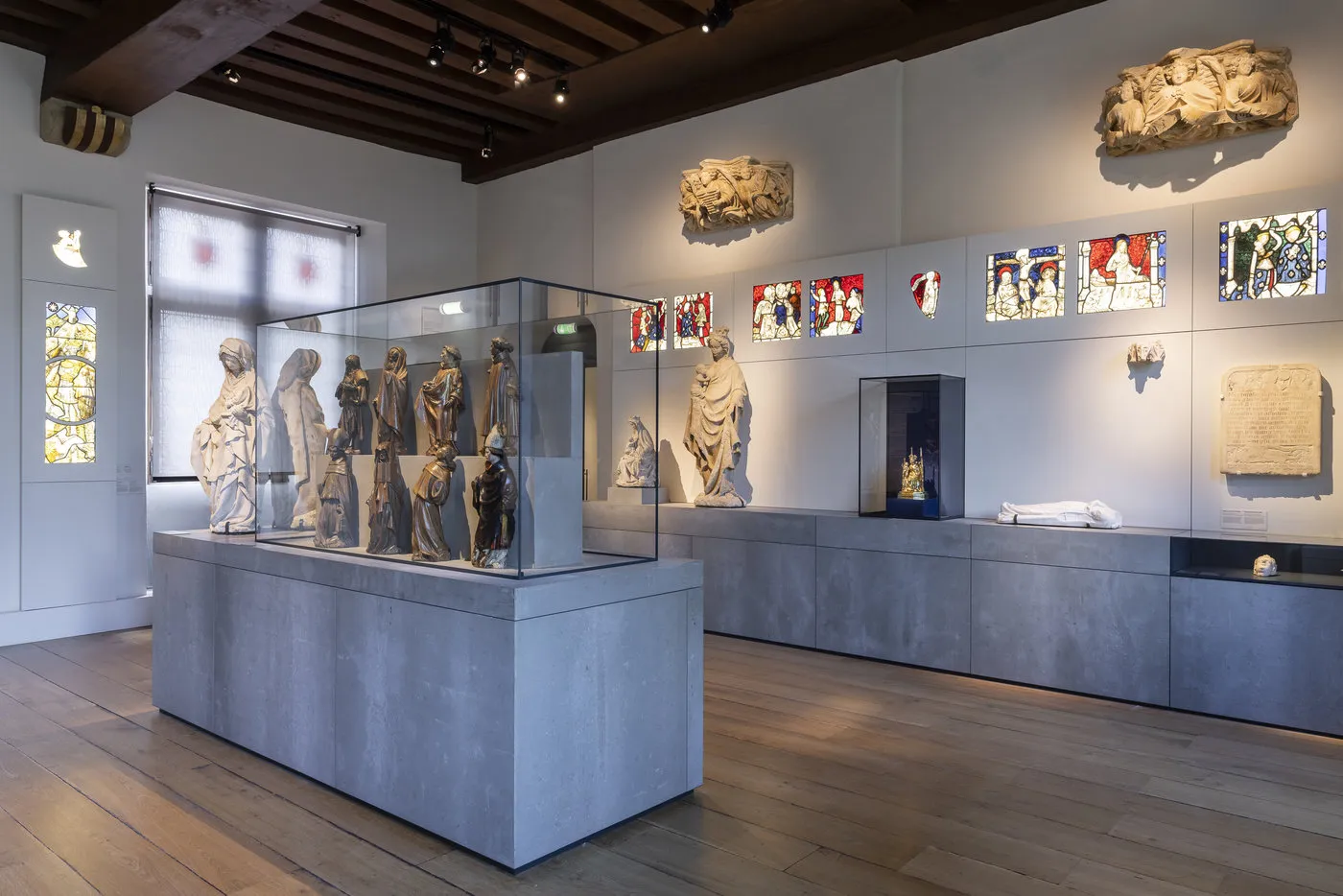
Room 13, French art at the early 15th century: an “international” art
© Alexis Paoli / OPPIC
Collections coming from elsewhere
The Musée de Cluny also benefits from the loan policy of the Museums of France. Since the 19th century, the Louvre Museum, for example, has loaned several works to the museum. These exchanges enable similar works to be brought together, shed light on a new aspect of medieval art, or showcase, in dedicated exhibitions, items that were previously kept in storage at their home museums.
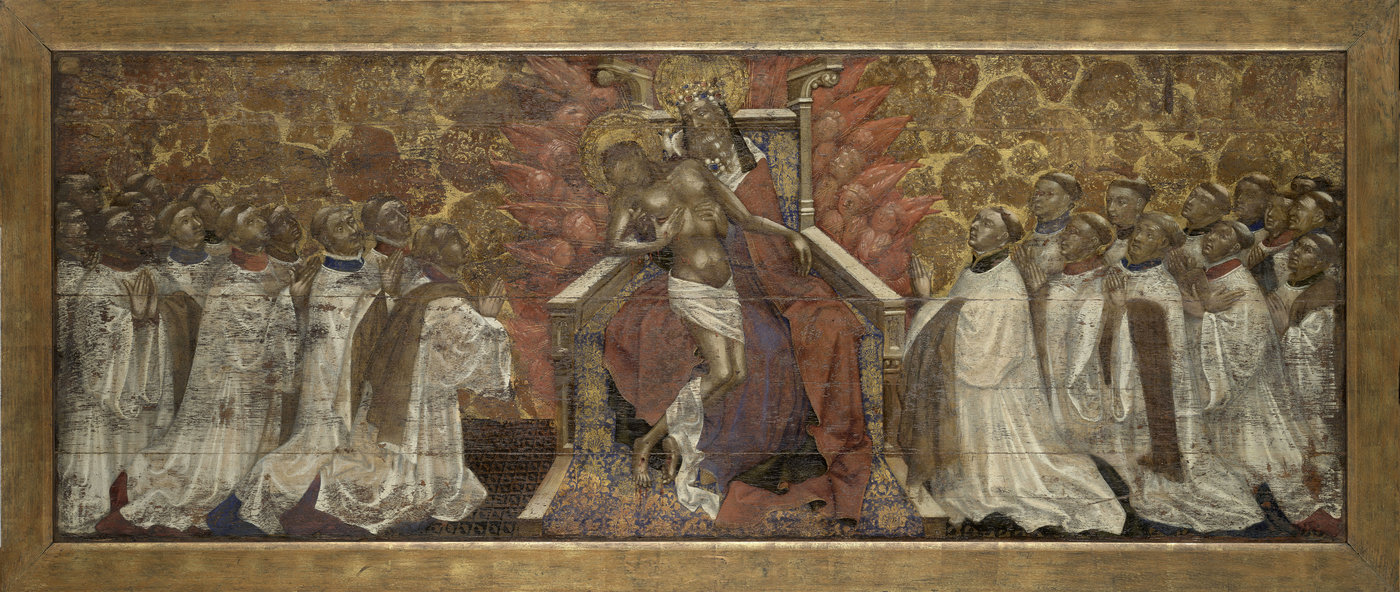
Trinity with the Canons, Mu 1261 (ENSBA) © Beaux-Arts de Paris, Dist. GrandPalaisRmn / image Beaux-arts de Paris
Trinity with the Canons by the Master of Dunois
Since July 2024, the museum has been exhibiting a panel painting from the collections of the Beaux-Arts Paris: The Trinity with the Canons by the Master of Dunois, painted for Notre-Dame Cathedral in Paris around 1440.
There are few surviving Parisian panels painted on wood from the first half of the 15th century. The Trinity with the Canons joins another panel painting, The Jouvenel des Ursins family in prayer, created between 1445 and 1449 and transferred from the Louvre Museum to the Musée de Cluny in 1985.
These two contemporary panels have crossed paths on several occasions throughout their history. Originally intended for Notre-Dame de Paris, they were transferred to the Musée des Monuments Français during the French Revolution. In 1816, the museum closed and the Couvent des Petits-Augustins, which had housed it, became the École des Beaux-Arts. Whilst the Jouvenel des Ursins panel was transferred to the Louvre, the Trinity with the Canons remained in situ. Following a major restoration carried out between 2021 and 2023, the École nationale supérieure des Beaux-Arts (Beaux-Arts Paris) agreed to loan the panel to the Musée de Cluny in July 2024.
The Trinity with the Canons panel is now on display in room 13, which is dedicated to early 15th-century French art.
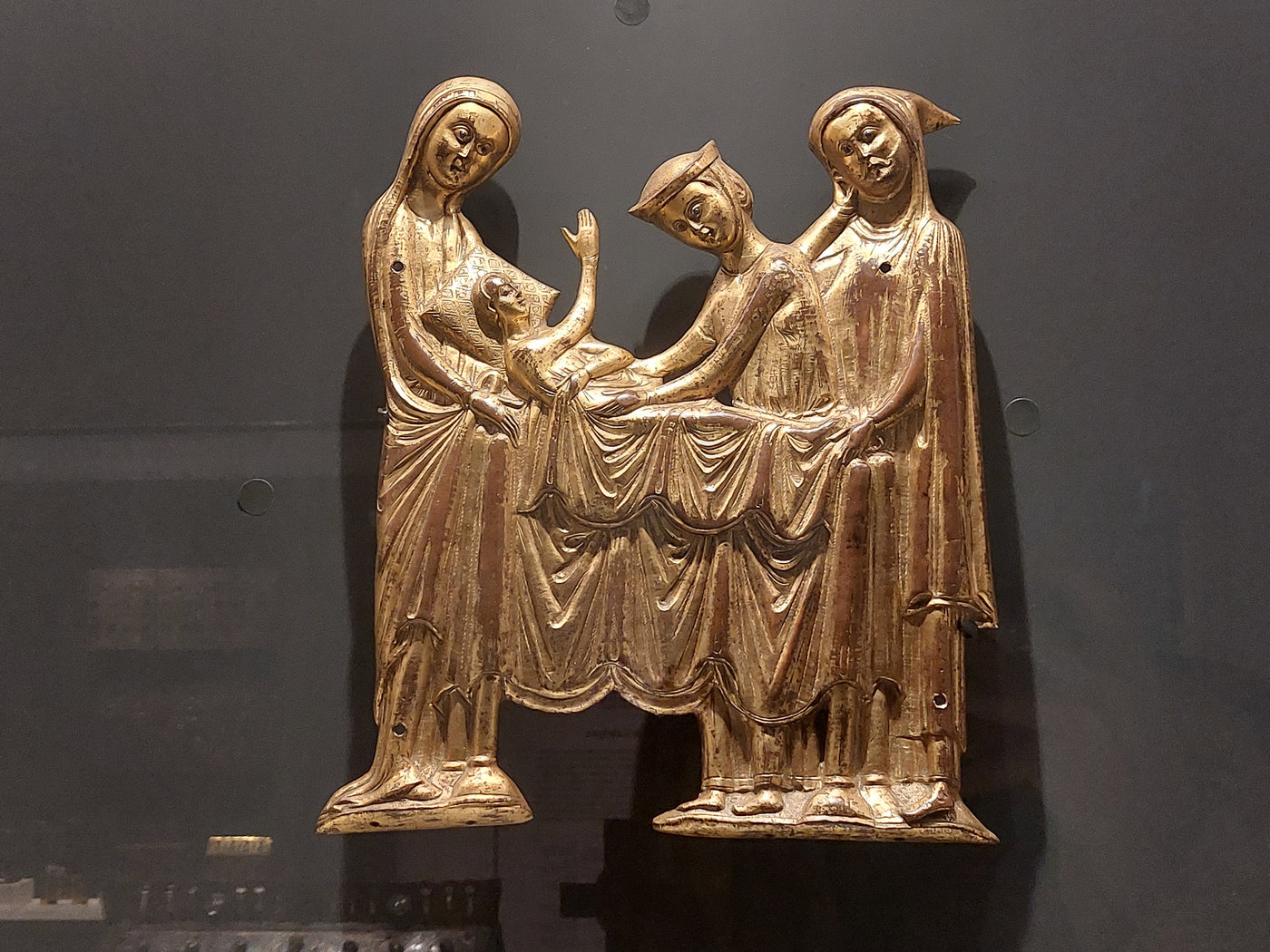
The Miracle of the Child of Ambazac © Musée de Cluny - musée national du Moyen Âge
The Miracle of the Child of Ambazac
Since October 2025, the museum has been hosting an exceptional set of embossed and gilded copper wall sconces. Owned by the Jacquemart-André Foundation – Institut de France, this piece is usually on display at the Domaine de Chaalis. Whilst the estate undergoes modernisation work, expected to last two years, it has been added to the museum’s significant collection of Limoges works.
Originating from Grandmont Abbey, the relief was no doubt intended to adorn a reliquary. It depicts an episode from the life of the abbey’s founder, Saint Étienne of Muret: the resurrection of the child of Ambazac.
This large piece (36 x 26 cm) dates from around 1250–1270. It is an example of 13th-century Limousin goldsmithing without enamel. It is on display until 2027 in room 6 of the museum, dedicated to the work of Limoges, alongside two reliefs in a similar style: a ‘Last Supper’ and a ‘Flagellation’.
This work has been loaned by the Domaine de Chaalis as part of its "Chaalis hors-les-murs" project, whilst extensive renovation work is being carried out on the château-museum.
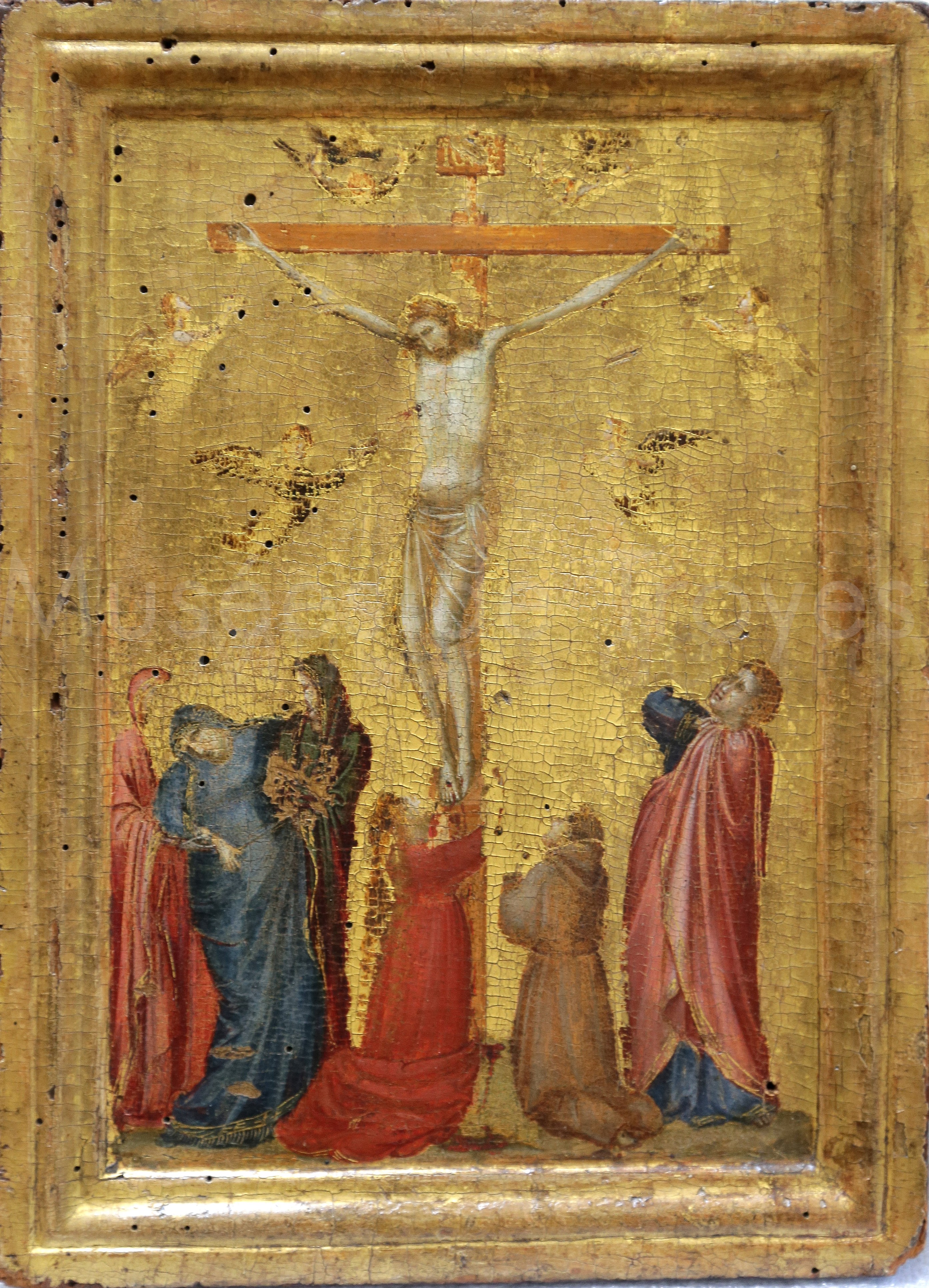
Calvary with Saint Francis of Assisi © Carole Bell / Ville de Troyes
Two exceptional painted panels from the Saint-Loup Museum in Troyes
The Troyes Museum of Fine Arts and Archaeology is lending two painted panels, attributed to leading artists of the late Middle Ages, to the Musée de Cluny. These paintings will be on display from the 20th of January 2026 until the 30th of March 2029 in the rooms 11 and 14 of the permanent exhibition.
The first is a Calvary painted around 1320 and attributed to Giotto’s workshop. The scene’s great expressiveness and the delicate rendering of Christ’s body bear witness to the Italian master’s innovations. They heighten the dramatic quality of the depiction. At the foot of the cross, his eyes turned towards Christ, stands Saint Francis of Assisi, who was the first saint recognised by the Church to have received the stigmata, the marks of the wounds of the crucifixion. The loan of this work completes room 11, dedicated to Italian art of the 13th and 14th centuries.
Dated around 1410, the second painted panel may be an early work by Henri Bellechose. The delicate rendering of the transparent veil draped over Christ’s hips and the facial features of the figures do indeed echo the work of the man who would become the official painter to the Duke of Burgundy. The presentation in the foreground of Christ’s body taken down from the cross is characteristic of modern devotional art, which places meditation on the themes of the Passion at the forefront. At the same time, the punchwork on the gold background, the preciousness of the pigments and the elegance of the composition bear witness to a particularly refined craftsmanship. Displayed in room 14, the panel engages in a dialogue with other works characteristic of modern devotion, such as the Pietà from the château de Tarascon.
If you would like to find out more about our collections, you can make an appointment with the museum’s documentation center.