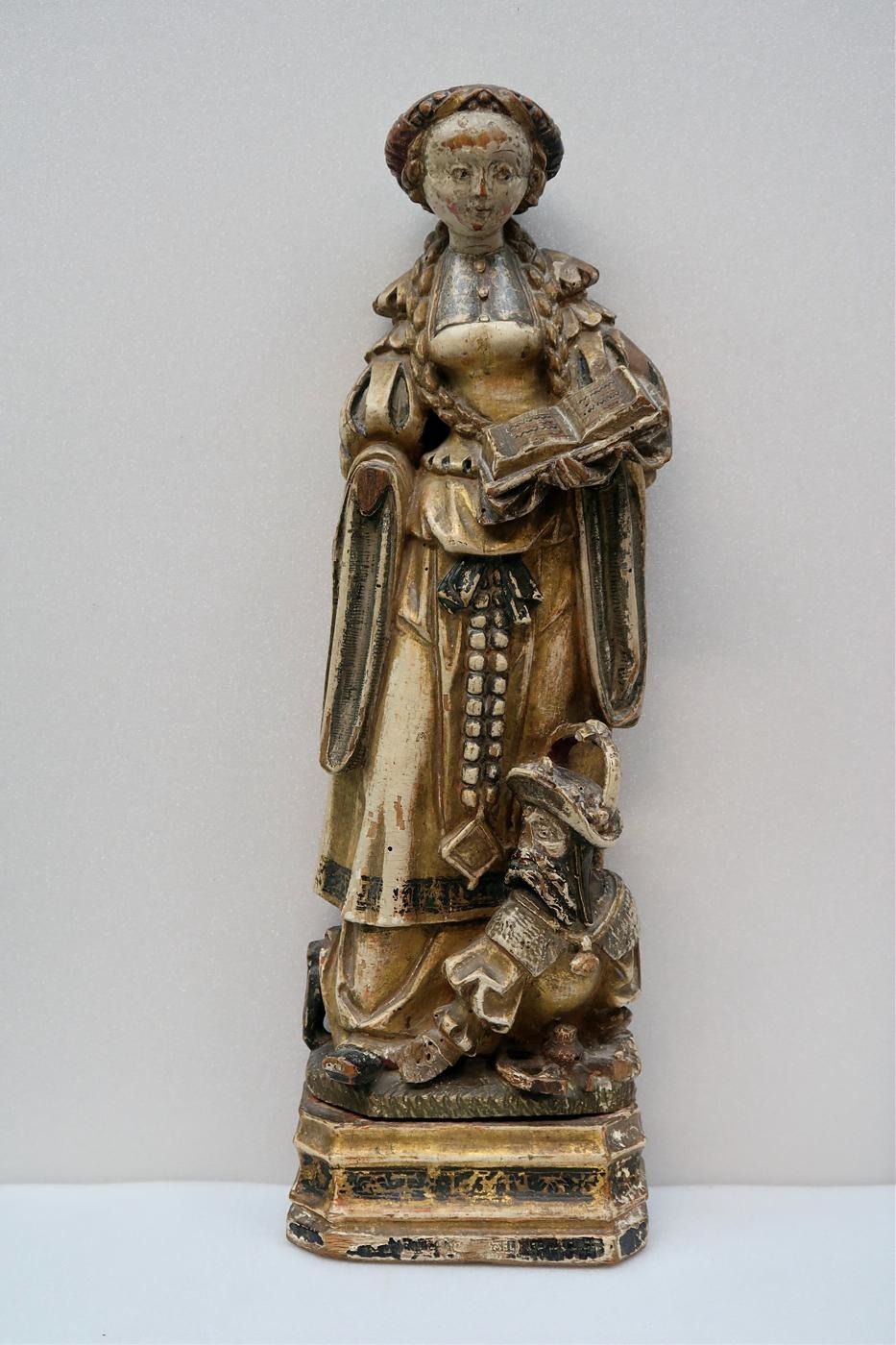
This statuette, characteristic of Mechelen's production, depicts Saint Catherine trampling Emperor Maximin, who condemned her to torture. It is part of a series of mass-produced sculptures that served as supports for private devotion.
Saint Catherine of Alexandria is depicted standing, trampling Emperor Maximin, who condemned her to torture, under her foot. On the grassy ground lies the toothed wheel of her torment, while in her now-missing right hand, pointing downward, she held the sword that was used to behead her.
This work is characteristic of the production of statuettes in which the Brabantine artistic center of Mechelen specialized from around 1500. The complexity of the clothing and adornments places it in the second phase of Mechelen production, from around 1515–1520. These mass-produced sculptures, intended to meet the growing demand for private devotion at the end of the Middle Ages, were widely exported.
Their production was governed by strict rules: the quality of the work at the main stages of manufacturing was attested by guarantee marks, all of which are preserved here. The three pallets of the city’s coat of arms, burned into the wood on the back of the statuette, guarantee the conformity of the sculpting work. The "M" for Mechelen (Malines), stamped in the gilding on the right thigh of the figure and repeated on the upper molding of the base, certifies the perfect completion of the polychromy. Finally, the painter’s personal mark is stamped on the lower band of the base and forms a small cartouche, now partially destroyed, where the initial "D" and the last three letters of the name "D[OERM]AEL" can be read, a mark found on several other examples. Additionally, the saint’s name, "KATELINA," is inscribed both in the central groove of the base and on the lower border of the robe.
Inventory number
Cl. 23984
Width
13 cm
Height
41,5 cm
Depth
7 cm
Place of production
Malines
Medium
Sculpture
Method of acquisition
Donation by Henri Gomez in memory of his wife Emmanuelle Gomez-Debever, 2024