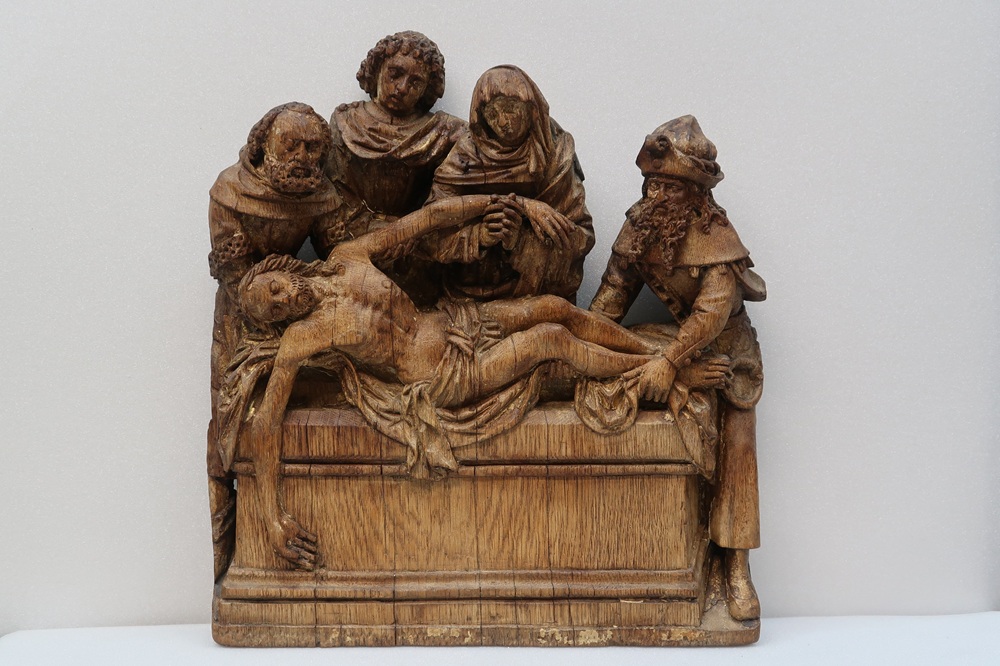
This altarpiece relief depicting the Entombment of Christ can be linked to the production of Beauvais. It may have belonged to a set of nine reliefs forming a Passion altarpiece.
The expressive and dynamic style of early 16th-century Beauvaisian production is evident here. The intricate shape of Nicodemus’s headdress, with its front edge featuring a curled appendage resembling cut leather, his bifurcated beard, and his hood with dangling ends, as well as the finely detailed beard of Joseph of Arimathea, are all elements found in other scattered reliefs attributed to this artistic center.
This piece appears to be particularly close to a group of nine polychrome wooden reliefs acquired by Alexandre Du Sommerard (1779–1842) and now preserved in the Musée de Cluny, which belonged to a Passion altarpiece. It could potentially fit into the foreground of the sixth scene, dedicated to the Entombment, in front of a relief depicting the Three Holy Women—a piece on loan from the Louvre to the Musée de Cluny, whose connection to the dismantled altarpiece has been confirmed by its physical proximity to the Musée de Cluny’s elements. The dimensions of the two reliefs, Entombment and Holy Women, seem compatible, as their widths coincide (28 cm and 29 cm, respectively).