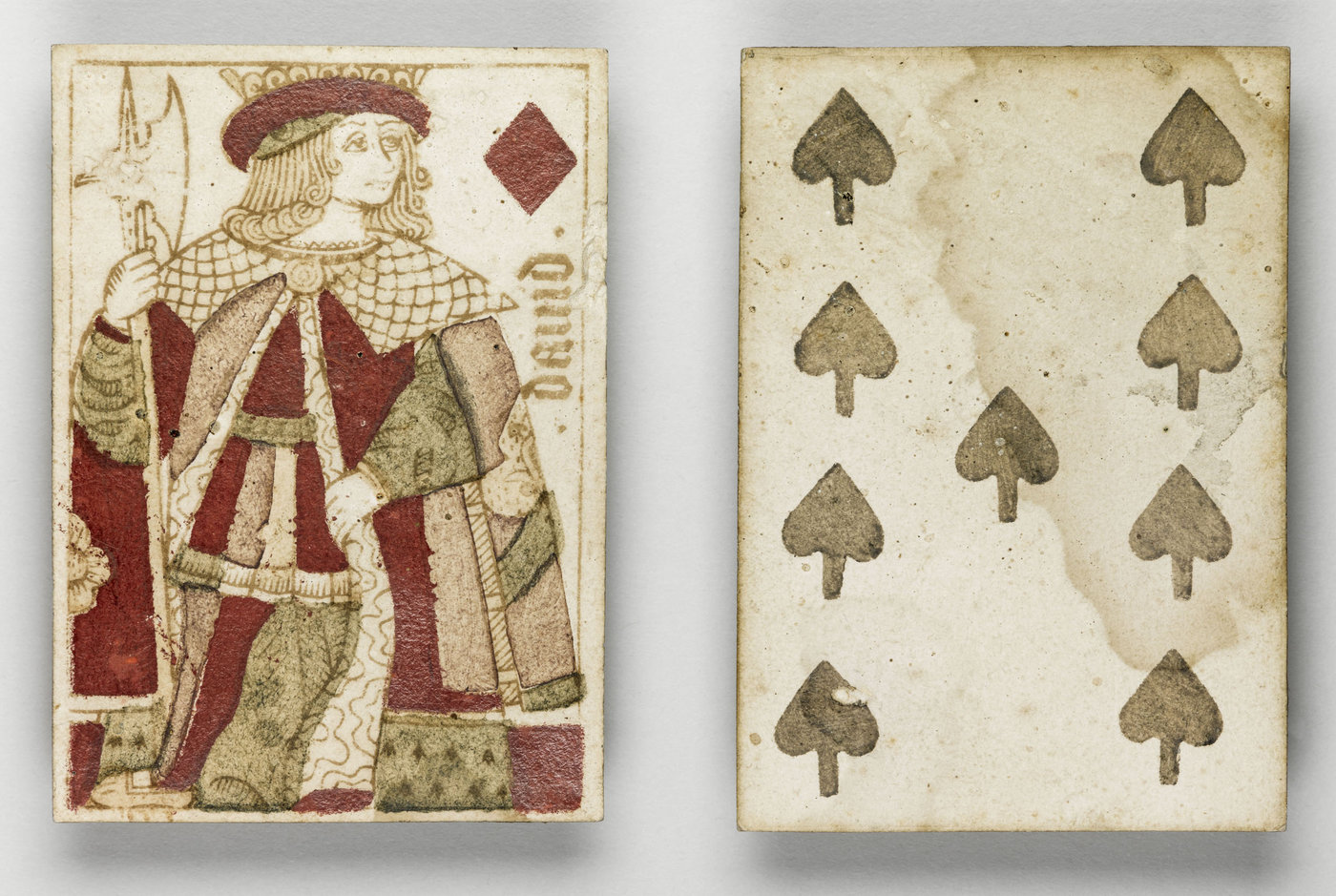
Two playing cards, Cl. 23890 and Cl. 23891 © GrandPalaisRmn / Michel Urtado
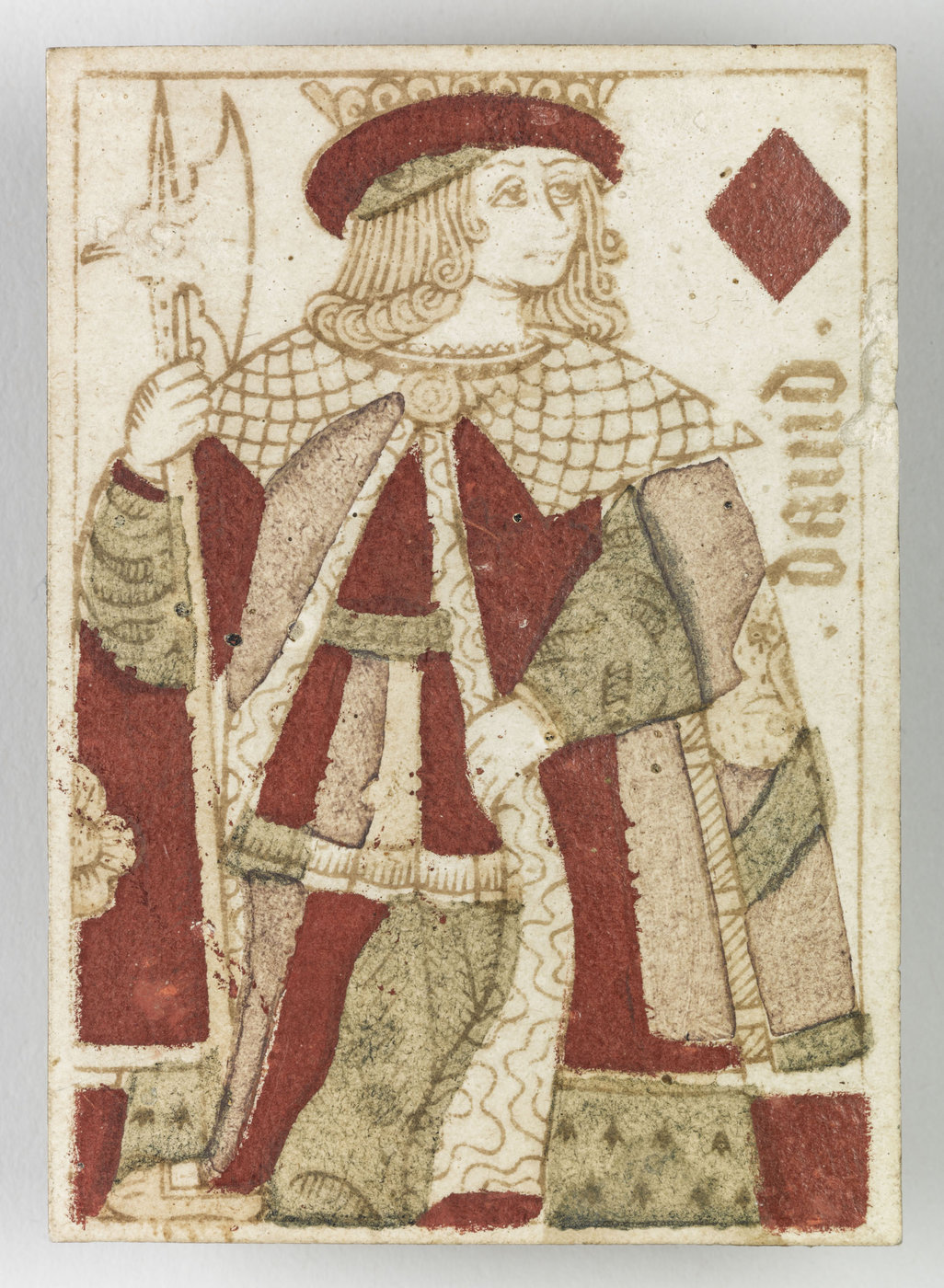
Two playing cards, King of diamonds, Cl. 23890 © GrandPalaisRmn / Michel Urtado
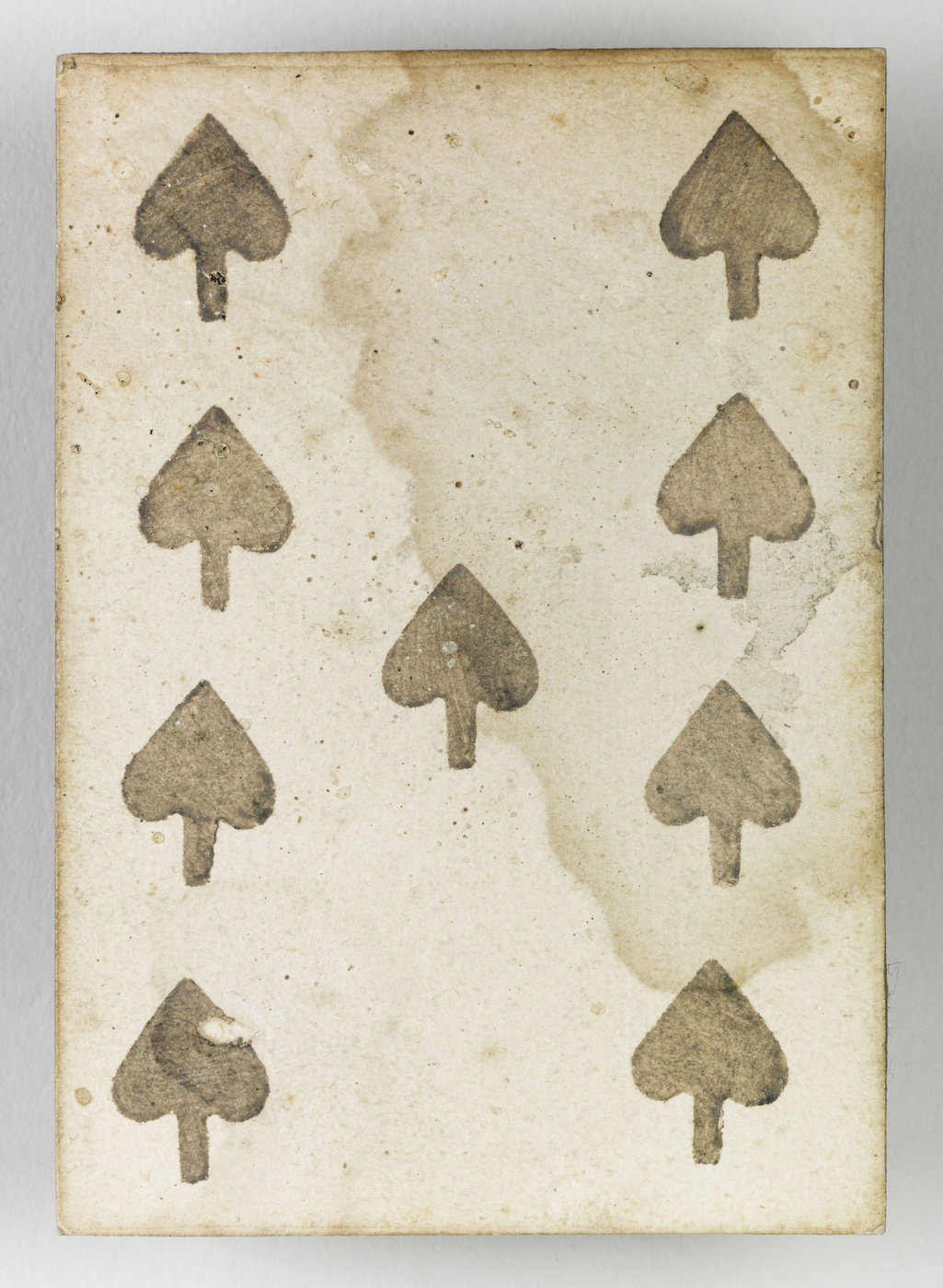
Two playing cards, Nine of spades, Cl. 23891 © GrandPalaisRmn / Michel Urtado
Two playing cards
King of diamonds and nine of spades
Description
The king of diamonds and the nine of spades held at the Musée de Cluny date from the first half of the 16th century. These two playing cards were created in the "large" format (approximately 100 x 70 mm), a typical size for cards from the 16th century. They were engraved and then coloured with pigments.
It was in Italy, in the 15th century, that playing cards were invented. At the end of the Middle Ages, printing enable them to become widely distributed. The production of playing cards primarily relied on wood engraving. This technique allowed for the reproduction of large-scale images, such as various game boards. The king of diamonds is identified as King David by the inscription on the edge of the card. Often shown as a musician king with a harp in his hands, he is nevertheless represented here as a warrior king, holding a halberd instead of his usual harp. The figure of David is quite widespread in mediaeval iconography. He appears in both Christian iconography (as the ancestor of Christ) and in secular iconography (to exalt royalty and royal lineage). The character’s style is close to that produced by the Lyon card makers around 1500.
The nine of spades is a card that was not kept as much as the king of diamonds. Keeping numbered cards from the 16th century was less common than those with figures. This card probably comes from a different set, but probably dates back to the same time as the king of diamonds, within a few decades.
When these two cards were sold by Tajan to the Musée de Cluny in 2012, they were displayed in a frame. A handwritten label was stuck to the back: "Playing Cards / Discovered at the Château of Blois, in an inlay in the niche above the entrance door to the Louis XII Building, by Captain Douet of the Engineering Corps, in 1839". More specifically, these cards were discovered hidden behind the statue of Louis XII on horseback (installed in the niche in 1502).
King of diamonds
| Inventory number | Cl. 23890 |
|---|---|
| Width | 7,1 cm |
| Height | 9,9 cm |
| Place of discovery | Château de Blois |
| Medium | Graphic arts |
| Method of acquisition | Purchased in 2012 |
Nine of spades
| Inventory number | Cl. 23891 |
|---|---|
| Width | 7,1 cm |
| Height | 10,1 cm |
| Place of discovery | Château de Blois |
| Medium | Graphic arts |
| Method of acquisition | Purchased in 2012 |