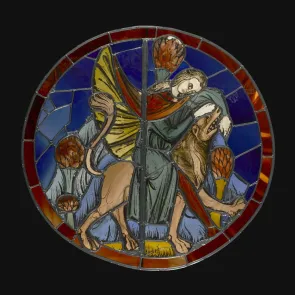
This circular applique medallion, once attached to an object, represents the story of the bronze snake told in the fourth book of the Bible, the Book of Numbers (21, 6-9). It was once attached to a religious object.
Yahweh, exasperated by the complaints of the Israelites, released venomous snakes among them. At the recommendation of Yahweh, Moses made a bronze serpent that, placed on a pole, that would save those who looked at it. The border features an inscription that explains the depicted scene: ENEVS.IN LIGNO.STAT.SERPENS.VULNERA SANAT ("A bronze serpent stands on a tree and heals wounds").
This medallion is part of a set of four pieces kept at the Musée de Cluny. All depict scenes from the Old Testament, including the Creation of Man, the Cluster of the Promised Land, and the Rock of Horeb.
They were perhaps once attached to a eucharistic casket or a tabernacle, such as that of Cherves (Limoges, around 1220-1230), kept at the Metropolitan Museum of Art, New York.
The iconography and the presence of inscriptions, which are very rare in the craftsmanship of Limoges, closely associate these medallions with the art of the Mosan, Rhineland, and northern France, and reflect the influences of the Limoges workshops on the northern artistic tradition.