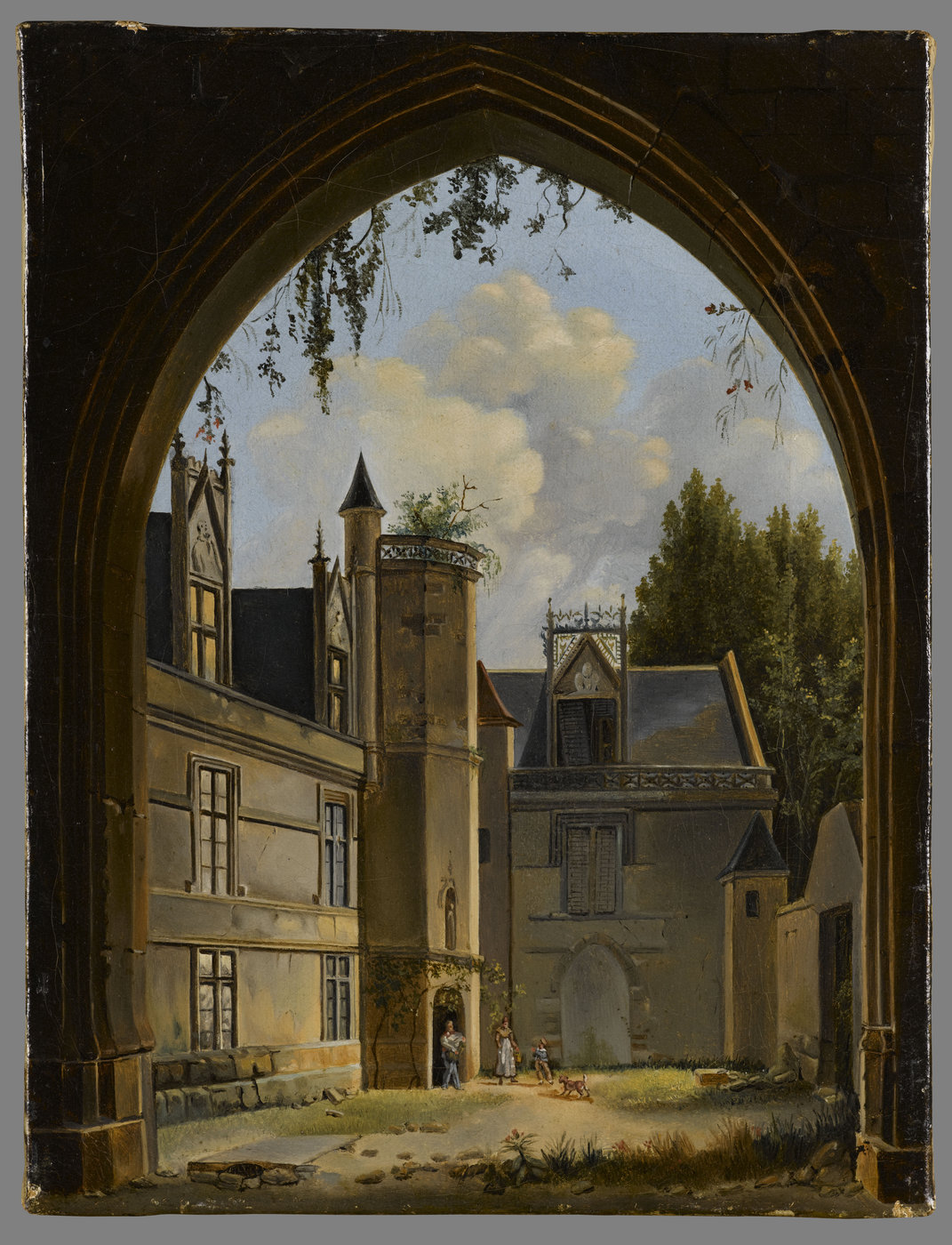
Truchot provides here the oldest known view of the courtyard of the Hôtel de Cluny. This painting reflects the taste of some 19th-century painters for architectural representations, particularly medieval ones.
Purchased on the art market with attribution to the circle of Etienne Bouhot (1780-1862) whose view of the interior of the frigidarium around 1850 is held by Musée de Cluny, this view of the courtyard of the Hôtel des Abbés de Cluny is in fact by the painter Etienne Truchot. The preparatory drawing, in which only the characters differ in the final composition, is held at the Fabre Museum in Montpellier.
Truchot, who had contributed to illustrating the "Voyages pittoresques" volumes, exhibited at the Salons of 1819 and 1822. Despite his dazzling career and life, he left remarkable views of architecture, which are as vivid and poetic as they are accurate from a documentary viewpoint. Throughout the 19th century and as early as the 1810s, the Hôtel de Cluny captured the imagination of painters, draughtsmen, engravers, and even photographers, who produced numerous views of its facades looking onto the courtyard and garden. However, this fascination with the Middle Ages found very few examples of civil architecture in Paris. The Hôtel de Sens, significantly altered, and the Hôtel de la Trémouille, which was destroyed in 1841, in fact left the Hôtel de Cluny proving all the picturesque inspiration.
The view of the hotel’s courtyard, from a point in the western gallery, certainly belongs to this 19th century appreciation of the Middle Ages, but it does so with a representation of ordinary Paris, in which the abbots' residence, which had been divided into apartments by that point, accommodated modest tenants and artisans.
The detailed rendering of the architectural form, which shows a historical state prior to Albert Lenoir's restorations – which are generally poorly documented – thereby provides a valuable record of the building's restoration. Truchot adds to his analytical ability of the subject some imaginary elements (busts in the eardrums of the skylights) to his analytical ability of the subject that add a poetic touch to this view.
This painting is seen as the oldest view of the Hôtel de Cluny, at least ten years before its prestigious tenant Alexandre Du Sommerard, took up residence on the first floor, who, by a twist which history alone has the secret, also owned a painting by Truchot, "Restes d'un monument d'architecture saxonne attenant à l'abbaye de Cantorbéry, en Angleterre", presented at the Salon of 1822.