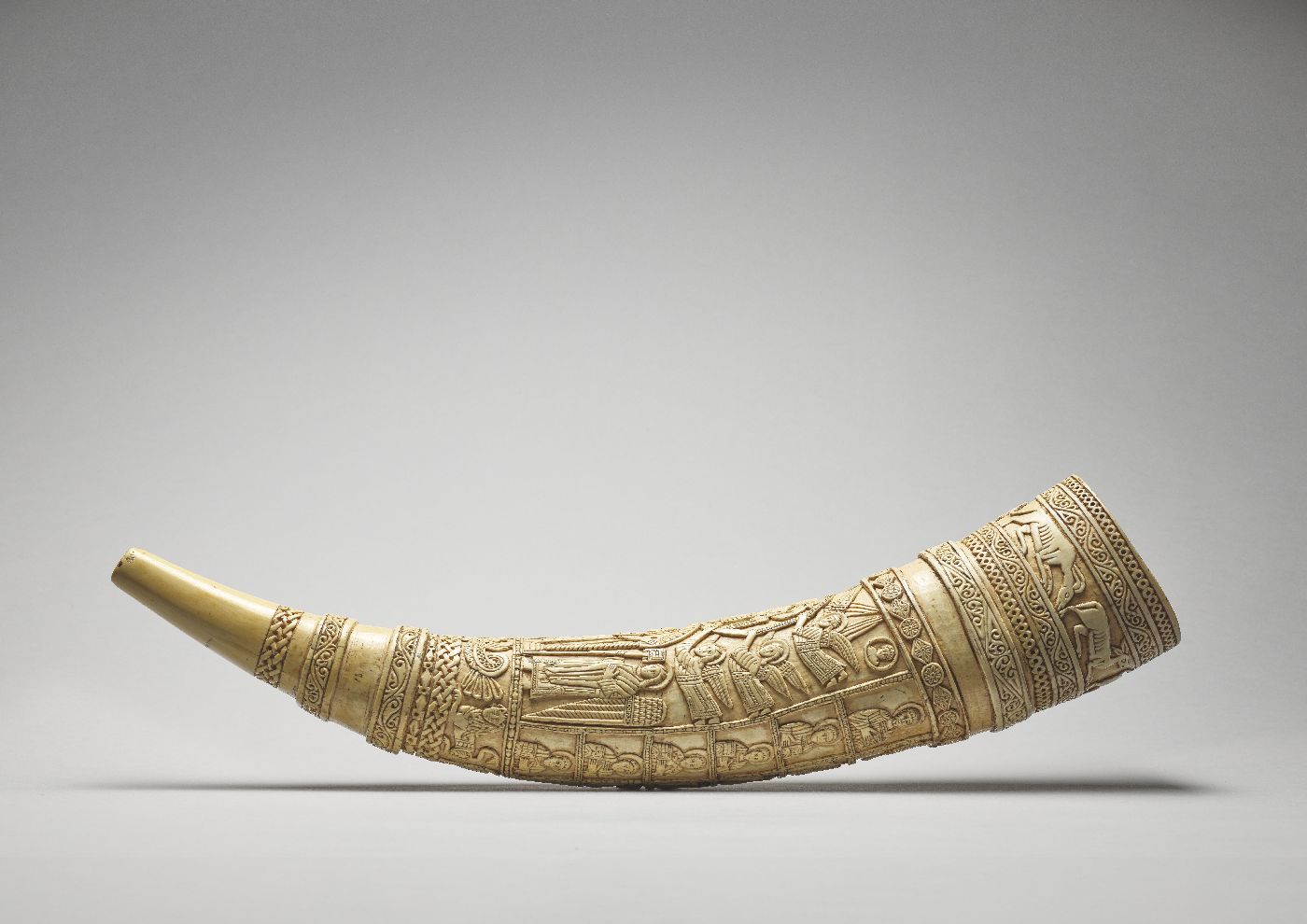
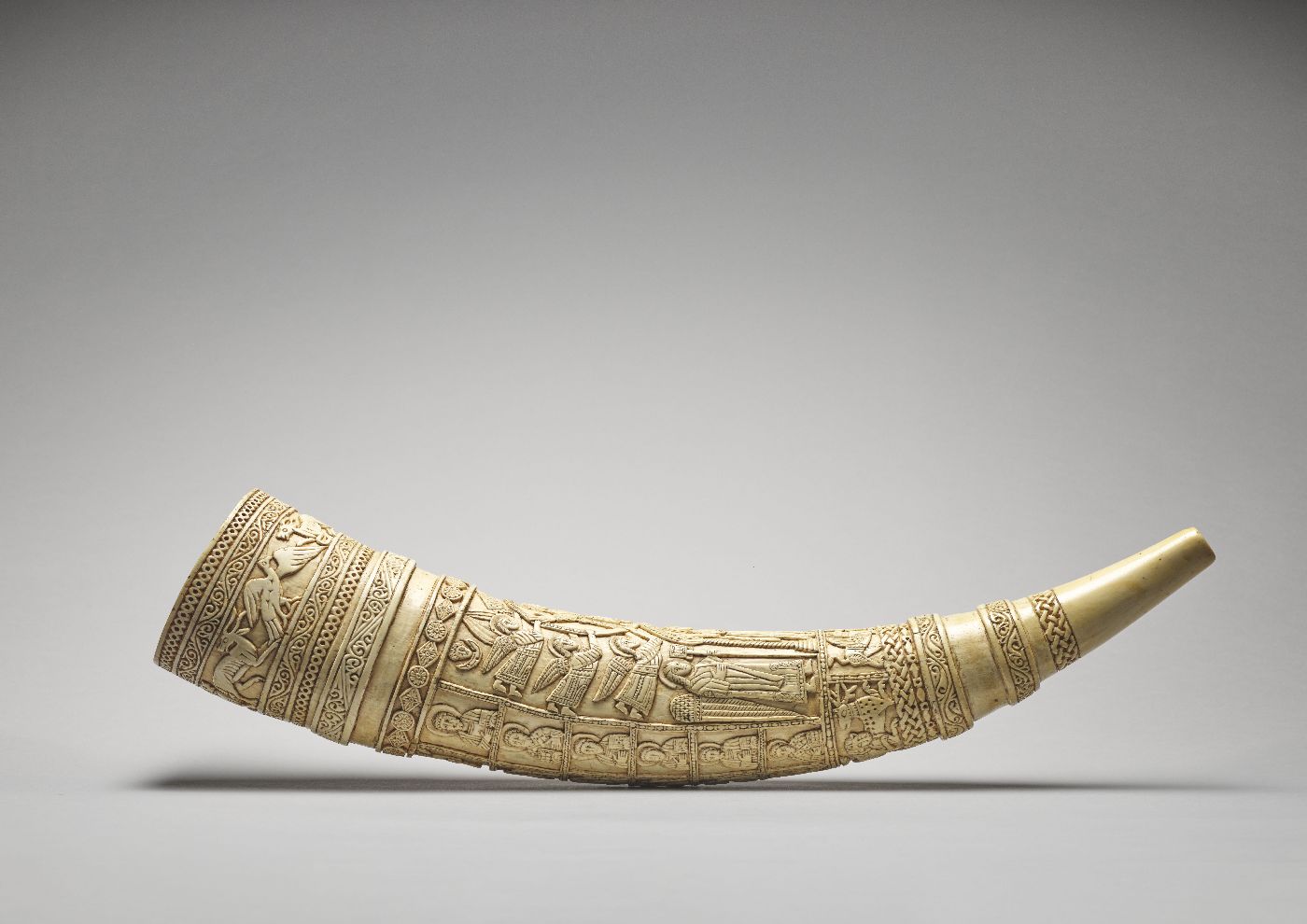
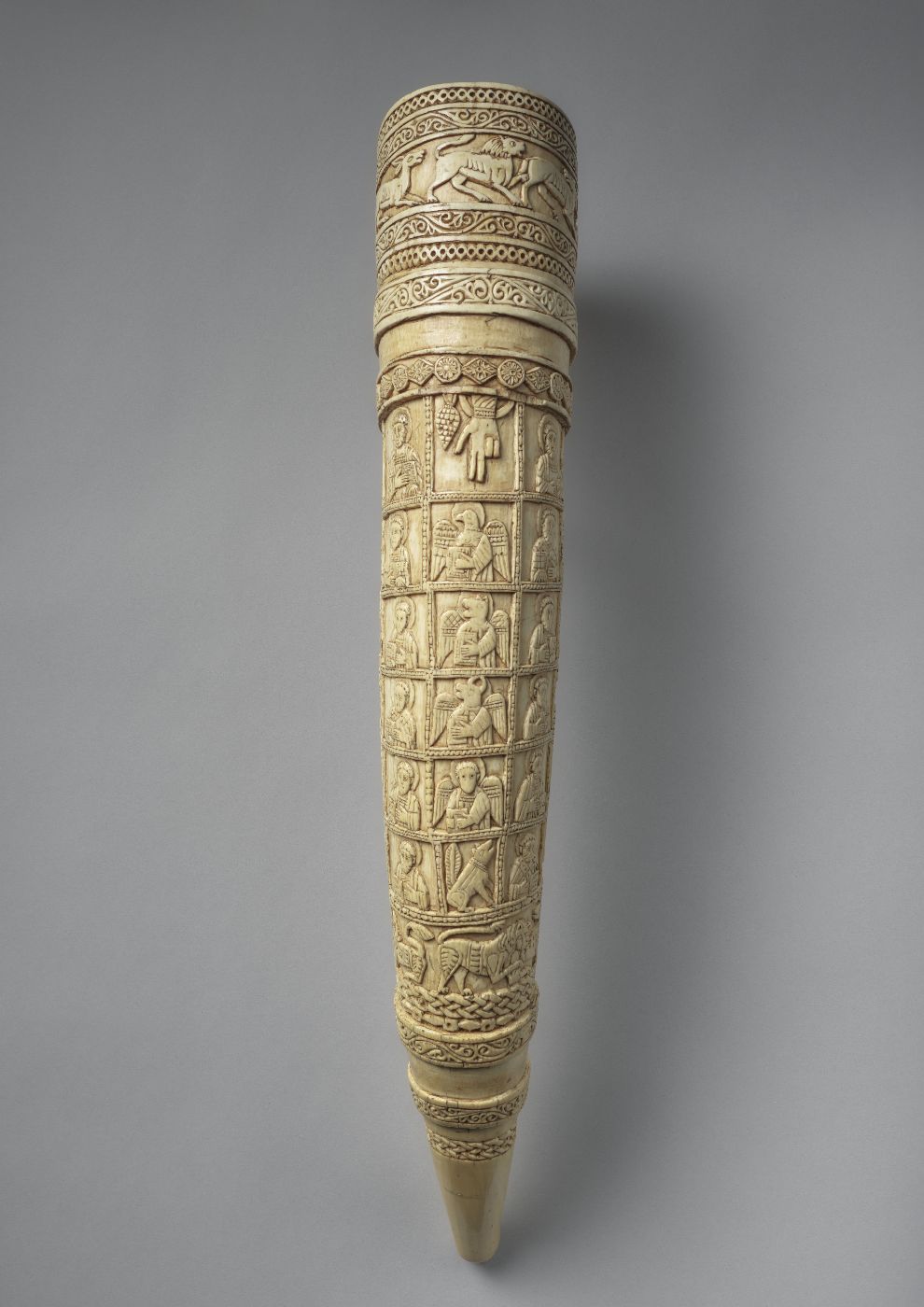
Carved from an elephant tusk, this object is a horn used for hunting or war. Oriental-inspired motifs are represented on the bands, while Christian iconographic scenes are found in the center.
This ivory piece was created in the 11th century. In the Middle Ages, oliphants were often associated with legendary events, such as the death of the hero in the Song of Roland. In this legend, Charlemagne's army is attacked at Roncevaux. Roland, a knight, sounds the alarm by blowing hard into his oliphant to the point of dying.
It has been carved with oriental-inspired patterns on the bands. A Christian iconography is laid out at the centre, which is rare for this type of object. The religious decoration is continued on both sides.
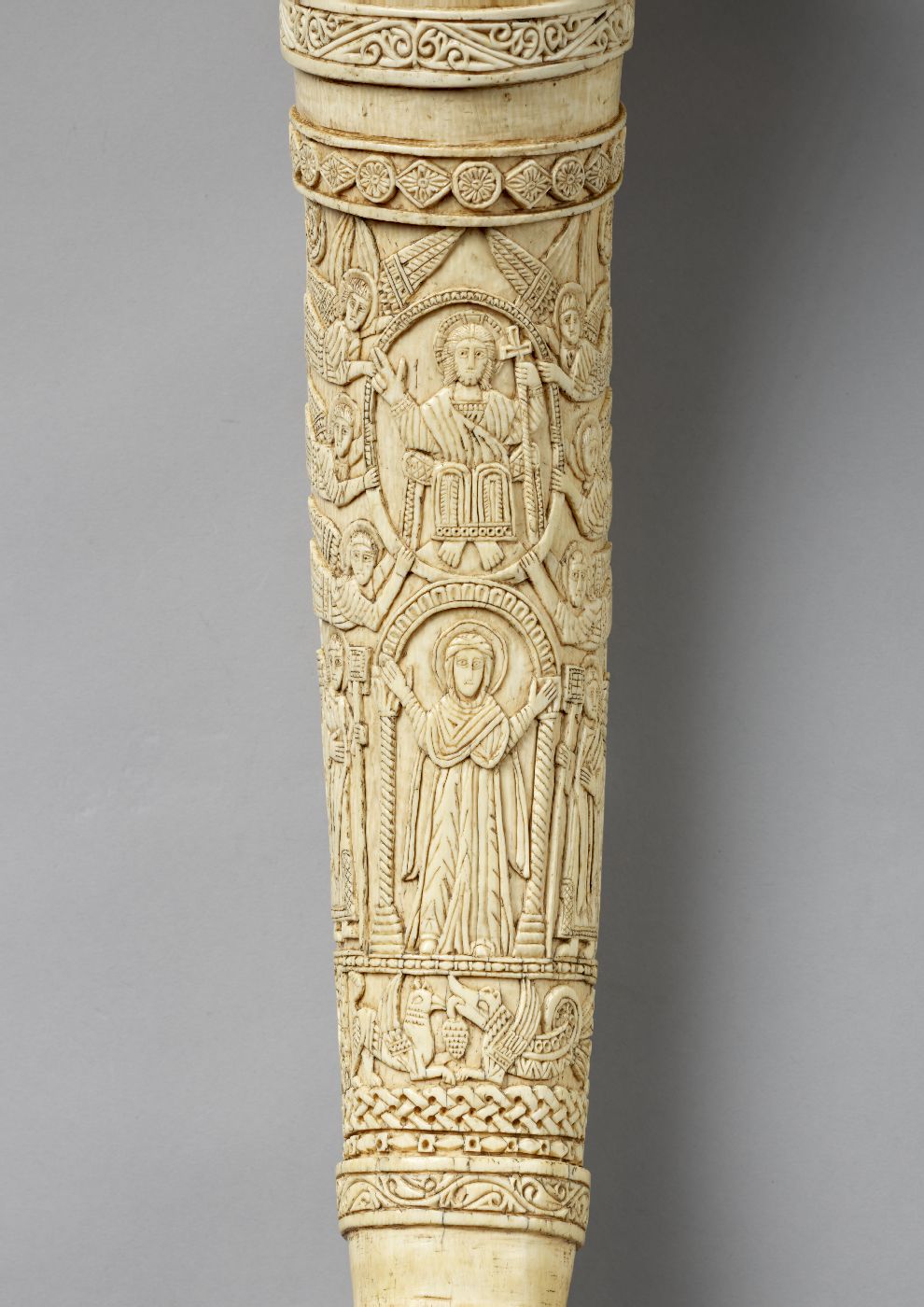
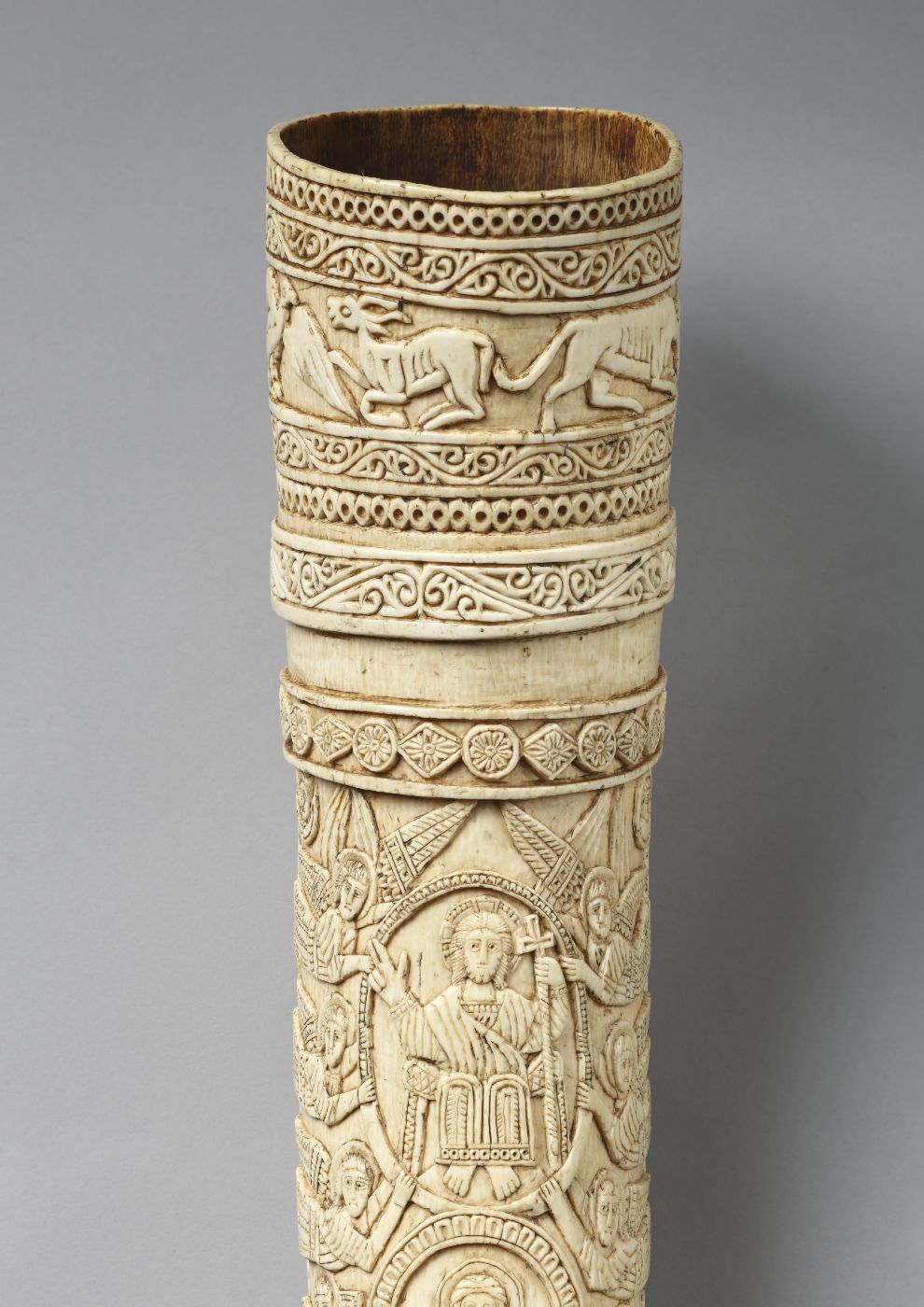
Two scenes overlap on the front.
The main scene, at the top of the horn, depicts Christ as King within a mandorla. He blessed the men with his right hand. With his left hand, he holds a cross, a symbol of his sacrifice and death on the cross to save humanity. On either side of Christ, flying angels hold the mandorla and lift it towards heaven. This scene depicts the Ascension, the moment when Christ ascends to heaven after his resurrection. Here, he is depicted in glory, symbolising his eternal reign over earth and heaven.
The secondary scene, located just below, depicts the Virgin Mary with her arms outstretched towards her son. She stands under an arch, in a posture of prayer. Two archangels surround the Virgin. They stand out from other angels due to the size of their wings, which are so large that they touch the ground.
On the opposite side, at the top, the blessing hand of God points downwards. It is blessing the four evangelists below. They appear in the form of a tetramorph. From top to bottom, the eagle of St. John, the lion of St. Marc, the bull of St. Luke, and the angel or the winged man of St. John can be recognised. They all hold a book in their hands : the four gospels forming the New Testament. Busts of saints are depicted on either side of the evangelists.
The influence of Byzantine art was evident in the schematisation of the figures and draping, as well as in the bas-reliefs, which are very flat.
It appears that a second workshop worked on the decorative bands that adorn the ends of this oliphant. More inspired by oriental art, scrollwork, rosettes, twists and friezes of wild animals (birds, deer, lions) are seen.
Oliphants in elephant tusks were rare in the Middle Ages due to their exotic origin and the precious nature of the material. Consequently, some of them were repurposed as reliquaries, or even considered to be genuine relics. Sometimes they would be added to church treasures.
This is the case for this oliphant, nicknamed the "Horn of Charlemagne", which comes from the abbey of Saint-Arnoul de Metz. This abbey housed a Carolingian necropolis and preserved numerous artefacts associated with the legacy of this dynasty.
According to a legend that lasted until the 19th century, this instrument was said to have served the Carolingian king in his hunting activities. But its dating means this hypothesis is discredited. Produced towards the end of the 11th century, it is highly likely that it came from a workshop in Campania. This region of southern Italy was involved in the ivory trade at that time. It specialised in the making caskets, chess pieces and oliphants.