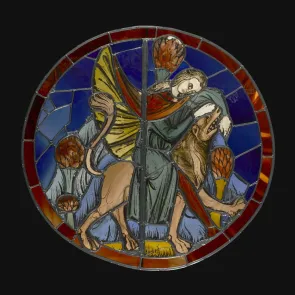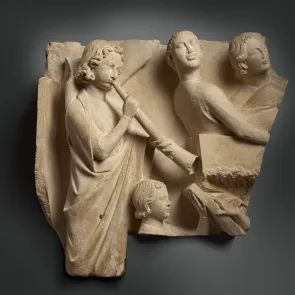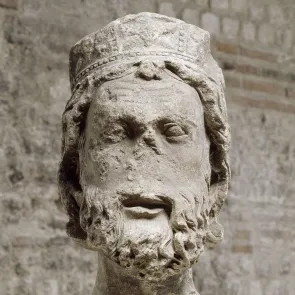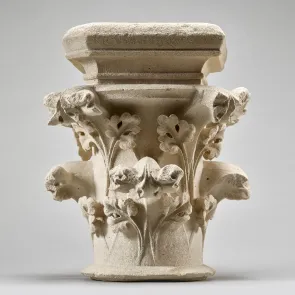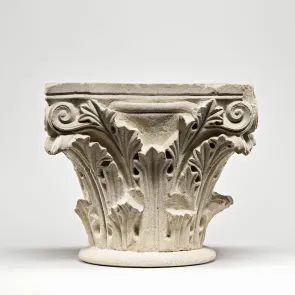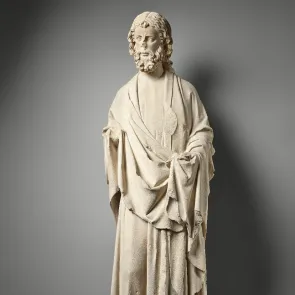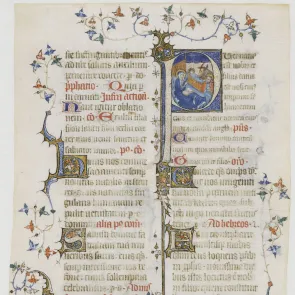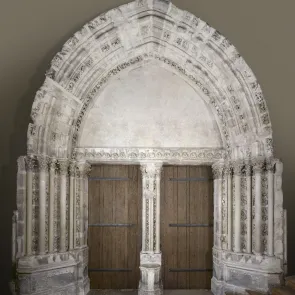
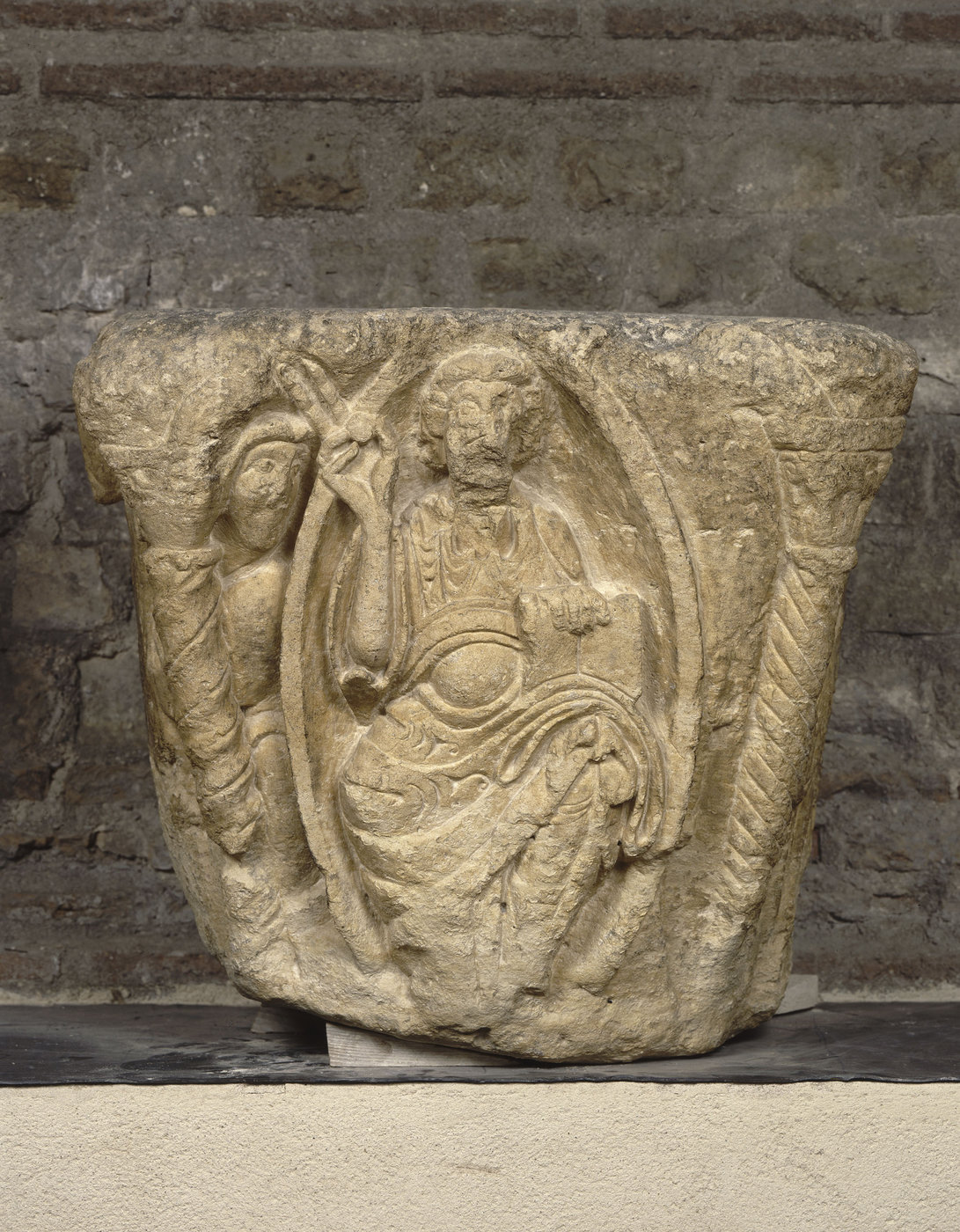
Capital from Saint-Germain-des-Prés, Cl. 18612 © GrandPalaisRmn / Gérard Blot
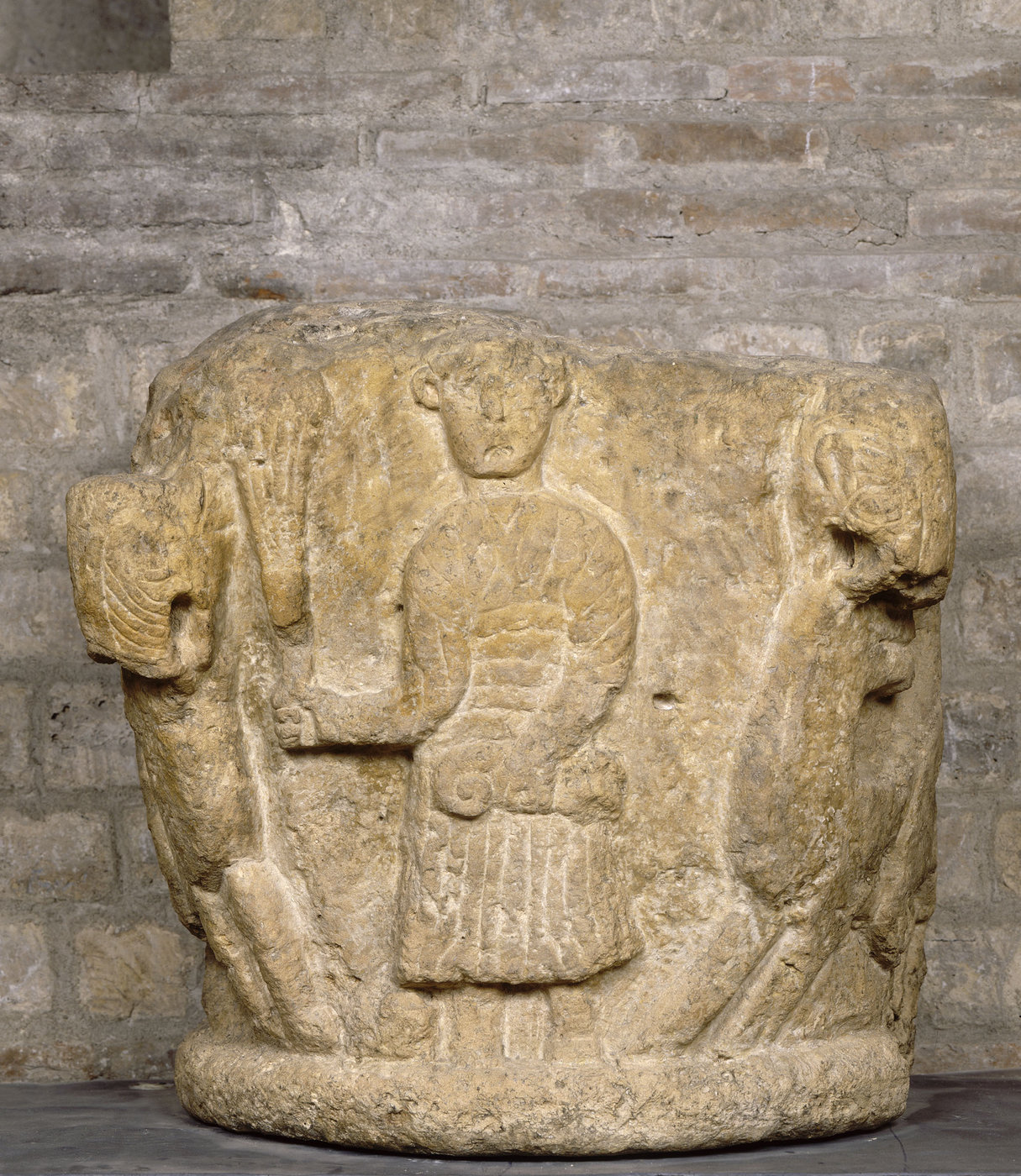
Capital from Saint-Germain-des-Prés, Cl. 18615 © GrandPalaisRmn / Gérard Blot
Embedded capitals (abbey church of Saint-Germain-des-Prés)
Christ in majesty, Daniel in the lion's den, interlace, palmettes
Description
These limestone capitals date back to the early 11th century. They belong to one of the most significant sculptural ensembles from the early Romanesque period that are still preserved.
They originate from the former abbey of Saint-Germain-des-Prés (Paris). In the Middle Ages, this abbey, founded by royal decree, was one of the most significant in the city. Its church was rebuilt in the 1020s and 1030s, at the very beginning of the Romanesque period. The capitals preserved at the Musée de Cluny were located in the nave of this building.
They can be attributed to three sculptors.
The first one specialised in botanical decoration. He produced the capitals with palmettes and long fluted leaves. Their stylised decorations are inspired by those of ancient Corinthian capitals (acanthus leaves, plant scrollwork).
As for the other two sculptors, they shared carrying out the capitals that depicted stories, i.e. representing characters inserted into a narrative. Several biblical themes are illustrated in this way: Samson battling a lion or the prophet Daniel in the lion's den.
One of the capitals presents Christ in Majesty. Sitting on a throne, he is within a mandorla, a geometric oval-shaped figure that symbolises his glory. It is a highly significant iconographic motif in Romanesque art. In his left hand, he holds an open book, most likely the Gospels. His right hand makes the gesture of blessing and holds a small disc between his fingers. It could refer to the earthly globe, a way of indicating that God is sovereign over the universe. But it can also be interpreted to be a host, the piece of bread that embodies the body of Christ.
At the beginning of the 11th century, the circles of theologians became agitated by a controversy concerning the Sacrament of the Eucharist. This sacrament was challenged in 1022 by theologians in Orléans. They claimed that the consecrated host was not the true body of Christ. The choice of this Eucharist theme for the capitals of Saint-Germain-des-Prés could be an answer to this quarrel. They help to uphold this sacrament and reaffirm the teachings of the Church.
Some capitals are difficult to read. The damage to them was caused by the church being turned into a saltpetre factory during the French Revolution. This is why, after major restoration work carried out in the 1820s, they were deposited at the Musée de Cluny and replaced by copies at the site.
Capital No. 1
| Inventory number | Cl. 18612 |
|---|---|
| Width | 76 cm |
| Height | 69,5 cm |
| Depth | 44 cm |
| Original location | Abbey church of Saint-Germain-des-Prés |
| Medium | Sculpture |
| Method of acquisition | Assigned to the Musée de Cluny in 1843 |
Capital No. 2
| Inventory number | Cl. 18615 |
|---|---|
| Width | 67 cm |
| Height | 69 cm |
| Depth | 44,5 cm |
| Original location | Abbey church of Saint-Germain-des-Prés |
| Medium | Sculpture |
| Method of acquisition | Assigned to the Musée de Cluny in 1843 |
Capital No. 3
| Inventory number | Cl. 18616 |
|---|---|
| Width | 62 cm |
| Height | 79 cm |
| Depth | 42 cm |
| Original location | Abbey church of Saint-Germain-des-Prés |
| Medium | Sculpture |
| Method of acquisition | Assigned to the Musée de Cluny in 1843 |
Capital No. 4
| Inventory number | Cl. 18617 |
|---|---|
| Original location | Abbey church of Saint-Germain-des-Prés |
| Medium | Sculpture |
| Method of acquisition | Assigned to the Musée de Cluny in 1843 |