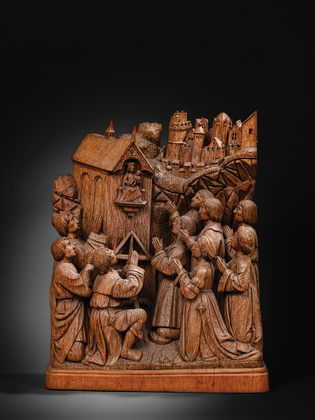
This wooden sculpture may have belonged to an altarpiece from Ourscamp Abbey. It depicts an episode from the miracle of the transportation of the Holy House to Loreto.
Around a small structure adorned with a seated statue of the Virgin and Child, nine laypeople are kneeling in prayer. Following a representational convention popular in the artistic centers of Brabant and adopted by workshops in northern France, particularly in Beauvais, the background is vertically aligned.
A landscape depicting a walled city unfolds on a kind of rocky ledge, defining an upper register. The cliff serving as the backdrop for the figures is carved into characteristic polyhedrons, while the grassy areas are worked "au tremblé" (with small, staggered chisel or gouge strokes). To the left, the structure, depicted in cavalier perspective, serves as the focal point of the scene. Its long side features two twin bays, while its gable is adorned with a seated statue of the Virgin, sheltered by a trilobed canopy.
A perfect match in dimensions, style, and iconography allows us to attribute this carved scene—unfortunately stripped of its original polychromy—to the same dismantled altarpiece as three reliefs acquired by the Musée de Cluny in 1939, which depict episodes from the history of the Holy House of Loreto. In the late 15th century, the account of the miraculous transportation of the Virgin’s house from Nazareth to Loreto, near Recanati in the Marche region of Italy, was transcribed into a cycle of prints, of which this sculpted ensemble is likely a direct echo. According to tradition, this altarpiece—the only known one dedicated to this theme—originated from the Cistercian Abbey of Ourscamp, near Noyon. Its style is related to the Beauvais sculptures of the early 16th century (1500–1520) but distinguishes itself through its geometrized volumes and the soft, calm folds of its drapery—a style also found in isolated reliefs preserved in Crépy-en-Valois and Compiègne, suggesting the existence of an artistic center further east, in the Valois region.
Inventory number
Cl. 23994
Width
43,3 cm
Height
54 cm
Depth
22,7 cm
Place of production
Île-de-France ; Southern Netherlands ?
Medium
Sculpture ; Wood
Method of acquisition
Preempted at public auction in 2025 with the support of the Fondation La Marck, under the aegis of the Fondation de Luxembourg