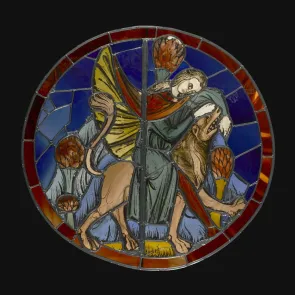
This plaque, created in the Meuse Valley in the mid-12th century, was part of a typological cross, meaning it made comparisons between scenes from the Old and New Testaments. The colour gradation is characteristic of the golden age of Mosan enamellers working in the 12th-13th centuries.
Few champlevé enamels of this type have survived, making this work even more rare; but its iconography, which represents an episode of the Old Testament, the encounter between the prophet Elijah with the widow of Zaraphet, is a frequently recurring theme.
The two pieces of wood shaped like a cross also reminds of the Crucifixion.